Saturday, November 5, 2016

Mike Nicastro and Dannel Malloy's Housing/Public-Transit Agenda

   Mike Nicastro is running for Connecticut's 31st District State Senatorial seat.  He is quoted saying that the State of CT has an income problem.  He proposes highway tolls that would be paid only by out-of-state travelers to close the budget gap.  I was unable to find any examples of where such a thing exists nor can I believe that the State of CT would establish a toll system and not collect monies from it's own residents.  Proposals promoting tolls as a way to fund regional transportation projects were introduced at Malloy's Transportation forums in 2014. 


 Mike gained attention speaking out against the busway in favor of light rail passenger service, declaring it the cheaper alternative by incorrectly equating the costs of the project to that of the Amtrak Downeaster.  Officials at URS at the CT Rail Study meeting I attended in 2013 called it the most expensive option.  As a preliminary stakeholder of the million dollar plus rail study he advocated for, he must know that passenger rail from Waterbury to Bristol turned out to be the most costly. 


The creation of passenger rail service involved an overhaul of 25 miles of the Pan Am line from Berlin to Waterbury including trains and equipment that would serve 800 or less customers at a cost of over $530 million dollars.  This equals more than $662,000 per person. That's enough money to buy each of them all a new home near their workplace and more than a dozen electric cars.


Busway service expansion from Bristol to Waterbury would cost a mere $5-$10 million.  The Central CT Rail Study report presentation on June 6th, 2016 meeting at the Bristol Public Library (to which the public was largely uninformed of) illustrates that passenger rail service isn't feasible at this time. 

Did Mike really care about the cost?

   As president of Central CT Chamber of Commerce,  Nicastro launched the slogan, "One Region , One Voice".  calling Bristol a "hub" of the region and wrote numerous articles citing the importance of public transportation in the future of downtown Bristol.  He called for the resignation of the chairwoman of  Bristol's Downtown Development Corporation for hesitating from signing on with Renaissance Downtowns plan to add thousands of units of housing near public transportation in downtown Bristol without any concrete financial plan nor concrete experience in 2009 and was quoted in the press stating,  “The lack of housing is why we don’t have a vibrant downtown.”  in 2011. 

 I've experienced a few interactions with this man whom has a robust knowledge about the state's goals for regional development projects.  Instead of walking away from the discourse with a better understanding of these goals as I had hoped, I found myself a target by more than a few stakeholders of the downtown Bristol Centre Square plan appraised at negative $33 million dollars.  
Way to derail conversations!

  It appears as though the point of most of the statements addressed to me were to imply that my concerns were based upon a conspiracy theory.  Was Mike making an effort to convince others there is nothing to be concerned about?

The risks of new urbanism projects are plenty.  Even experts in the industry such as Donald Shoup admit that you can sometimes exasperate the problems that the goals New Urbanism seeks to remedy using such a urban renewal recipe.  But instead of allowing the residents of Bristol to have an educated conversation of the risks, trade-offs, and goals of a TOD (Transit-Oriented Development) project as Reconnecting America advises as best practices, this man declared that the downtown project was not about transportation.   "Agenda 21 has no place in the conversation about downtown", he wrote.  Then this same man brought it up over and over.


    Mike continually labeled anyone vocally concerned as anti-downtown development, anti-investment, negative and accused some of them of not offering of other alternatives.  Yet in all actuality, of the few people that were vocal about their reservations, none fit the profile he concocted.  Some people took to the microphone at public meetings and wrote in to the paper in their own defense but Mike did not stop with the public branding.  
Criticism of these policies should elicit a professional explanation of their merits and not false accusations and ad hominem attacks on private citizens if we are to have an open society. 
  Most astounding to me was his assertion that Depot Square "is not about transportation" in spite of dozens of documents and statements proving otherwise. Pointing out the most recent minutes of the Rail Study  to validate my claims, Mike simply deflected that the CCRPA was now defunct.  The very same minutes were mirrored on the rail study site.  I posted them, was blocked from the social network group and the post was deleted.  This appears to be how he deals with people whom ask questions. 

 Mike's name appears on the Central CT CEDS (Comprehensive Economic Development Strategy), which is a long-term economic development plan that regionally addresses demographics, employment, housing and transportation. So I was alarmed to hear him downplay the expanding role of regionalization in the state by identifying it as a cost sharing thing between municipalities at a recent debate.  It is remarkable that Mike's has such experience with how state grant monies and land use planning are intricately connected and he has not made mention of it here either.

  This is particularly disturbing because Nicastro condemned Senator Martin for not supporting Senate Bill 1, the  first bill introduced this year by state democrat party leader Looney, Duff and Fonfara.  The part of the bill that is linked to the heart of the Nicastro campaign is the creation of "Innovation Districts" with entrepreneurial start-up assistance.  This original legislation was defeated and the subsidiary of the public-private entity Connecticut Innovations called "ImpaCT" never came to be.  Nicastro said he testified in favor of the bill and helped work to change the draft of this legislation.  Mike's campaign would like you to think that Mike is being independently innovative about job creation.   That's quite a play on words. 

 After the close of the legislative session, the democrat led state legislature drafted the biennium budget bill and stuffed the CTNext "Innovation" program in it.  The program is is virtually the same.  The bill states,   

"In determining whether to approve an application for innovation place designation, the CTNext board shall consider... the commitment to, implement and administer the master plan...whether such plan includes ...sufficient measures to ensure walkability of the geographic areas within the municipality.... adequate and accessible public transportation; and .... affordable housing options..."


  Initiatives like these pick the winners and losers at the expense of the middle class.  This agenda is the same one you see playing out in Hartford, West Haven, Newington and every town and city in a transit corridor or a future planned transportation corridor.   That agenda is about public transportation, affordable housing and reducing carbon emissions from personal automobiles to combat global warming, as much as it is about jobs.  One could argue that it is the primary focus but we'll just leave it up to the reader to decide.


Official Testimony against SB1


Sunday, July 10, 2016

Is It Government, Not Citizens, Guiding Bristol's Future at Public Workshops?

On June 18th 2016,  the City of Bristol held a public workshop at the Tunxis of Bristol location to solicit public input for the Route 6 Corridor Planning Study.  Despite the discussions at public meetings, a local story about the meeting, and the promotion of it by at least one city official and myself, the turnout was quite dismal.

 The fact that the majority of those in attendance were either members of the Planning Commission or otherwise some other form of government official was discussed during the meeting.  So I when I saw this quote in a local publication it stuck out like a sore thumb.  I was not the first, nor the only one who noticed.  In addition to what seems like a plug for the city's branding effort, the quote would seem to imply that there was a large amount of public input from the general citizenry gathered.  I am not the only person whom feels this is not the case. 

The people in the photo below are all either members of government or associated parties save for two or three.  One is a member of consultant company commissioned for the Route 6 Corridor Study and one for consultation for downtown Bristol redevelopment, one is a city councilor, two are former Chamber of Commerce Presidents (one of which is running for State Senator), about a half dozen are members of the City of Bristol Planning Commission.... well, I l could go on but am sure you get the point.


  The charrette leading the meeting had hoped to break us into smaller groups so as to have smaller conversations and lead us through to achieve a particular objective as all charrettes do. I was however  not convinced that was a good way to solicit public input under these circumstances so therefore I objected.   I was not the only one to object either.   Even Councilwoman Mary Fortier agreed that pubic attendance was minimal stating that only six private residents were in attendance (as you can see for yourself at this link  in a short video clip.)

 In the end there was a consensus that there would be an open public discourse and we moved on together.   Discussion covered various areas in the corridor, the pros, cons and suggestions for those areas.  All members of the public all were allowed to discuss their views in part, but some were not pleased with the turn of events.  As one member of the public in attendance described it.


" When the question was asked can we move from development to the traffic issues we were shut down. The consultant also twisted the statistics - 20% of the residents have lived in the area since 1969 - and are aging out. But no one mentioned the other 80% who are younger! Very frustrating meeting."
The meeting actually ended at around 11 a.m.- An hour prior to the scheduled end.

  Some members of the city's boards, commissions and associations provided comments at the public meeting in support of certain initiatives that do not appear to be held on a level of high importance with the general public.  Perhaps the municipal meeting held prior to the public one was a different format or perhaps some of those speaking were unable to attend the other meeting.  That is not to imply that when members of the community become government officials, that they cease to be citizens of the community.

  Nevertheless, no reasonable person can deny that the city's planning workshops are lacking in attendance of members of the general public.  In this instance, the government is basically soliciting input from the government themselves in the public's stead.  This is not a good way to have proper representative government, nor see future development guided by the citizens themselves.    I hope that this problem does not reoccur when planners for Bristol's downtown solicit public input or else we could possibly see the city head in a direction that most residents won't enjoy to go.  It could happen, and has happened in other communities.

   I've included images of the 'information gathering technique' charts dotted with the concerns of those in attendance.   It seems that most are concerned with traffic flow despite the fact that the study itself focused predominantly on development.  I wonder if traffic concerns will be used as a reason to concentrate housing and development in a place where most residents do not want to see it occur.  


There was NO support for apartments in the downtown gateway section of Rte 6. 


  Most of the workshops I have attended have been predominantly attended by municipal representatives and 'interested parties'.    Hopefully we will see more members of the general public in attendance in the future.  I created an event on Facebook for this workshop but few of the members of government I invited shared the event.   The reason why they do not create a Facebook Event and invite all of the city on their own escapes me.  City officials could also target Facebook ads to local residents informing them of the workshops for a small amount of money as suggested by one local resident.   I have recently brought this suggestion to the Bristol Development Authority Downtown Committee in hopes they would incorporate it to their public outreach plan.  Whether or not it it will make any difference ultimately depends on the effort of the general public and the effort of their municipality to reach them. 

  Some residents have asserted that they feel that the city would prefer to limit public involvement as these readily available tools to encourage attendance of such meetings are not being utilized.  Some have concluded that all some are seeking is manufactured consent and have pointed to the article as an indicator of such.   Do you feel that city officials are making every effort to reach the public and garner their attendance?  Do you feel that the article from the local paper implies that there are sufficient outreach efforts and results for such important decisions about the city's future?


(Video Courtesy of the Bristol, CT Open Government Project)

Sunday, April 17, 2016

Who Wants Bike Paths Downtown?

Is there any harshness in living without an automobile or is it a modern-day utopia? Are we perhaps living in the land of contraries?  Either way, the City of Bristol is moving forward with it's agenda of providing a system of bicycle routes, beginning in the most controversial location possible.  As proposed, the Veterans Memorial Boulevard will become a gateway to the city by cutting off one lane of vehicular traffic.

We are told that this idea originated locally from our Park Board, Veterans Board and the Bristol Police Department.  And who is the average Joe to complain?  We the citizens are given a variety of reasons why we should shut up and deal with it.  We are told by some that since the veterans sacrificed their lives for our country and they are okay with it..."  and we are told that "the police department is in charge of traffic", and that., "the experts whom did the traffic study know what is best."    We are also told that, "It was at the Park Commission city meeting and if you didn't go you have no right to complain."  Yet even though the issue did not make print, nor was it mentioned anywhere prior to it being approved, this is the narrative.  One other half truth floating around is that the Memorial Boulevard closes into one lane at each end when in fact it breaks down to three lanes at the west end.   Nevertheless, I heard a rumor  that there is going to be a new city meeting about it on the 20th to allow the public to participate in the process, but I can't seem to locate any information about it on the city website, in the local paper, nor the mayor's Facebook page.  Is this a coincidence or a pattern?

If you believe the "official story" being put forth you must not have seen anything that precedes this local processes as of late. So where did the bicycle lane idea come from?   Let's have a look back in time and you can decide for yourself where this idea originates.


The City of Bristol conducted a survey of it's residents as part of it's Plan of Conservation and Development.   In this instance, according to the contracted firm's representative, what kind of bicycle path would be suggested was not explained.  Survey participants were simply asked with the leading questions below.   Would you suppose that the person at the end of the telephone was suggesting closing one lane of Memorial Boulevard?


So here it is, bicycle paths in Bristol's PoCD (Plan of Conservation and Development) which was approved in June of 2015.  It appears that this happened more than seven months months before the Park Board had it on their agenda


Bicycle circulation pathways are mentioned several times in the 2015-2025 PoCD for Bristol.


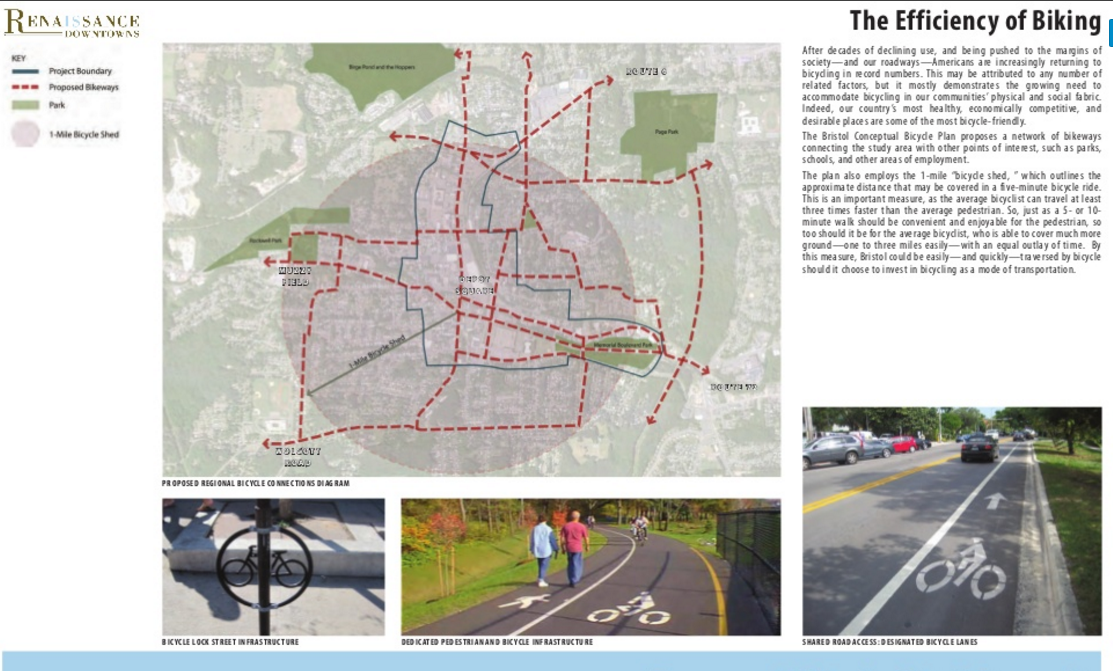
The Plan of Development also suggests that the city "reduce city street widths", which could prove costly should high snowfall totals accumulate over the course of the winter in these areas.We even see the suggestion of painting bicycle lanes in the PoCD as well as the establishment of a network of bicycle routes. The planning commission included a map of suitable locations for the network in the Plan. 


I had not noticed earlier but the route from the Planning Commission PoCD map places the route along Riverside Avenue and not on Memorial Boulevard.  The safety of that route appears to be questionable.  Perhaps the city's Park Commission facilitated the change from state guidelines which appear to suggest the pathways follow state highways.   Riverside Avenue is the roadway that is designated as Route 72 despite the awkwardness of the detour from a straighter path.

One would think that a roadway described as a "Gateway to Bristol" would have a planned two-lane road for automobiles if the goal were to improve traffic flow and improve commercial activity.   But the course that the city is on will close one lane and make the gateway a "bicyclist's utopia" as initiated by planners, developers and big government.   The DOT has been working on a statewide plan for bicycles for quite some time.  In 2009 they adopted a plan that identifies Bristol's lack of inventory of such a system of bicycle routes and the city's PoCD identifies this while addressing the survey results.  

This is all connected to the New Urbanist "walkability" concept, where bicycle racks become a primary concern over the creation of jobs that would allow residents to live self-sustaining lives without having to forfeit their personal transportation.


The PoCD tells a different tale than the local paper and some of our local politicians and their political allies.     Bristol does not live in a bubble where state and federal policy does not influence decision making.   The City of Bristol's Master Plan calls for integrated planning and undertaking of actions to "improve public transit options".
Complete Streets is mentioned in this segment of the PoCD as well as the federally funded nonprofit, "SmartgrowthAmerica".  SmartgrowthAmerica and the National Complete Streets Coalition have teamed up to address climate change by making efforts to reduce carbon emissions, according to their website.
    
The policy shares the same goals as the CTFastrak Bus-Rapid Transit program.     The adoption of Complete Streets law dates back to 2009 and is modeled for incorporation to TOD projects such as the CTFastrak oriented plan for Bristol's downtown.


The State of Connecticut Department of Transportation Complete Streets Report states that,
"motor vehicle users have been the prime consideration for designers.   This has created a motorized vehicle dependent society."  
Do you think that rings true?
Either way, the Master Plan for New Britain's Fastrak-Oriented development appears not on their city website, but on the Capitol Region Council of Government's website.  Unlike in the local press, the incorporation of the practice was widely publicized prior to implementation.


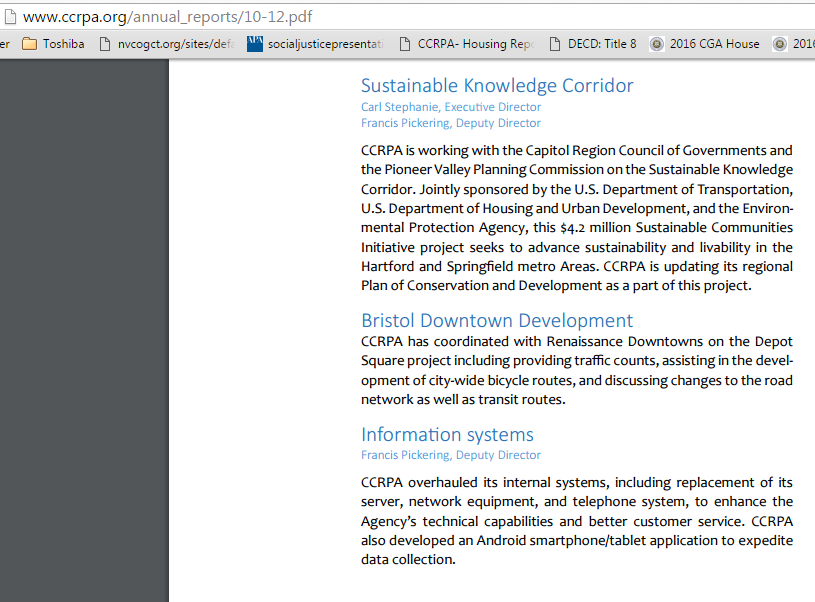
Another thing that Bristol shared with New Britain besides it's transportation planning is the fact that relevant planning documents appear on state websites instead of the city's.   The PoCD mentions the Forestville Plan, which appears on the Central Connecticut Regional Planning Agency (CCRPA)  website.   The CCRPA includes the plans of the bicycle routes in it's 2012 report.

Also mentioned in the CCRPA 2012 Report is fact that the CCRPA worked with Renaissance Downtowns providing the traffic counts and took part in the development of bicycle routes..   Their 2011 Concept plan illustrates the fact that the effort began long ago under a premise that is now being buried.


  The CCRPA is now a defunct but the Bristol's Metropolitan Planning Organization is the CCMPO, whose involvement is illustrated on the Capitol Region Council of Governments website..    You might be able to influence the outcome of this development, but it.appears unlikely to me.

But don't take my word for it.   Listen to Bristol's Transportation Committee official explain it to local Democrat councilors eager to connect the trail to Plainville at a city meeting.


Sunday, January 24, 2016

Free Sidewalks for Low-Income Landlords? - CDBG Money in Bristol, CT

According to federal mandates, Community Development Block Grant (CDBG) monies must be used to predominantly benefit low-income and moderate income families.  But do these federally allocated HUD monies earmarked for such use achieve the goals they are intended to produce? Or could it be that these taxpayer monies might possibly be benefiting less needy individuals?   This is the case made by more than one local resident.

This year, the City of Bristol has decided to once again amend it's Annual Action Plan, by reprogramming CDBG funds for sidewalk replacement.  $68,000 in federal funds are proposed to be used for sidewalk replacement in the Summer Street Target Area.   Upon inspection of the Summer Street vicinity, it appears that the area most in need of sidewalk repair happens to be in the area closest to the city's main library.    A short animation shows that the sidewalks are in a clear state of disrepair.


Some planners and state officials, including those from nonprofits such as the Local Initiative Support Corporation (LISC), (whom is managing the State of Connecticut's Transit-Oriented Development Predevelopment Fund), seem to think that sidewalks improve the quality of life of low-income residents because physical mobility lowers the walker's Body Mass Index (BMI).   It seems like that's a bit of a stretch of legitimate use.  The question at hand is, do these funds best fit the bill for their intended use, or do they more greatly benefit those that the funds are NOT targeted for.   City resident and taxpayer Tom Doyle Jr. isn't the only resident whom thinks this is an issue.   He is one of the few whom has provided a public statement for the Bristol Development's public hearing for the funds' use.   It states in part,


" I'm a moderate-income taxpayer living in this neighborhood.  I know that most of these buildings are apartments owned by landlords that don't actually live there.  They're responsible for these properties and must pay for sidewalk replacement, by law.  You're not helping low- and moderate-income families with this proposal -- you're actually hurting them.  You're rewarding the absentee landlords who these poor families pay their rent to, the ones that use that money to do anything but repair and maintain their blighted buildings and properties. ....
...
The fact is, it may not even be legal to use this money to redo the sidewalks.  The city ordinances specifically state that sidewalks must be maintained, repaired, replaced, and kept clear by the property owner and not at the expense of the taxpayers."

 I met him for a quick "On the Street" video a few weeks back.   


Among other residents opposed to the use of low-income funds for landlords was the former teacher and father of Tom Jr., Tom Doyle Sr.   His statement to the BDA (in part), is included below,

"The city has proposed that $68,000 be taken from community block grants to repair sidewalks on Summer St.  We citizens are getting a snow-job.  Sidewalks are the responsibility of owners - in this case some absentee landlords including one who has been called a scumbag by our Mayor....
...    The sidewalks wouldn't need to be repaired if dumpsters were kept off them, if cars did not park on them, if driveways were simply paved.  Otherwise landlords create problems and the taxpayers are forced to pay for them...."


Bristol's Historic District Commissioner and Federal Hill resident Steve Coan weighed in,

"This particular area of the city seems to be one of those areas where the city's code has not been properly enforced.   Summer Street has been a haven for slum lords for years and the idea that we are now going to reward this behavior by giving them new free sidewalks is absurd. "

One property owner at a popular downtown business found the practice unfair to long-time taxpaying residents.  He recently dished out more than $7,000 to replace the sidewalks in front of his vibrant new $15,000 awning.   The investment was privately funded.  Ineligible for the city's Enterprise Zone incentives, this business owner is paying more than his fair share for businesses investing just across the other side of the railroad tracks.

If the purpose of using taxpayer monies for sidewalks in downtown Bristol is to improve it's 'walkability', the money is not likely being best used to predominantly benefit low to moderate income families.   The Central Connecticut Metropolitan Planning Organization's Transportation Plan for Central Connecticut -2040 illustrates that Bristol is 'very walkable'.  It seems that HUD funds are being directed to the same place that roadway monies are being diverted to in this manner.

The public hearing for the amendment has ended effectively on the 18th of January.   The Bristol Development Authority will address the public comments for the sidewalk allocation of federal Housing and Urban Development(HUD) monies at it's Monday January 25th meeting at 5:00 PM immediately after the public comment segment of the meeting.

Sunday, December 27, 2015

Double Bill Emergency

Is it a dire emergency?  One can only surmise as to why there is a double bill venue at 6 pm on Monday at Bristol City Hall.  The two special meetings scheduled for Monday, December 28th are both regarding the sale of property on Bristol's former mall site.  Both the Board of Finance and the Special City Council meeting are scheduled for the same time.  This sale of the public's property happens to be subject to a waiver of the City of Bristol's procedures.
 The Board of Finance agenda states:


 To waive Section 2.G.2 of the Purchasing Policies regarding disposition of real estate, relative to the sale of property at Depot Square to Bristol Hospital and to take any action as necessary"

 The City Council's agenda states:

"To convene into Executive Session to discuss an offer to purchase City owned property at Main Street and Riverside Avenue."

and
 "To reconvene into Public Session and take any action as necessary regarding an offer to purchase City owned property at Main Street and Riverside Avenue."


I fear that there may be reason for public concern.   It appears that the last article to appear in The Bristol Press about the issue may indeed be the last article published there by the city's favorite civic reporter. His resignation, which has garnered national news attention, sheds light onto his wife's reason for resigning in 2011 and it's relationship to the hospital's affairs, stating that she,

"quit in disgust after Mr. Schroeder cut a deal with a major advertiser, the local hospital, to keep a damaging news story under wraps."
 Both of the Collins' have resigned while controversy was amidst regarding the hospitals' affairs.  I honestly do not know if they are relative or just coincidental.  .  One thing for sure is that regardless of the intent of Connecticut's Sunshine Laws, Steve Collins' FOI request regarding the Letter of Intent pertaining to the conditions of the sale to Bristol Hospital was recently rejected by the City of Bristol.   The reason stated was,
"because it was a preliminary draft"  

Mr.  Collins' request further states that under sec. 1-210(b)(1) of the State of CT General Statutes that,

 "preliminary drafts or notes" can be exempt from FOI "provided the public agency has determined that the public interest in withholding such documents clearly outweighs the public interest in disclosure."
 One would think that public deals concerning public land and possible public debt would be subject to public disclosure.  If the public interest is not determined by the public itself then what can be said for representative government?  Who decides what is best for the "greater good" or the "common good of Bristol" if it is not the citizens themselves?


As revealed in the article,

"Among the questions that city officials are weighing is how to cope with the parking needs for a building with 250 or more employees... "
Apparently, a consolidation of downtown offices and a consumption of available parking lot will place an unnecessary burden on patrons in the name of new construction and relocation.  As I have indicated in the past, the downtown plans have always been to include public parking garages that would come at a high and unnecessary cost to taxpayers. Could that be a condition of the sale?  If so, will taxpayers' hands then be tied?

 We cannot be sure what to expect under these circumstances.  But under these circumstances, it's hard not to ask a moral question.

   Has the City of Bristol declared itself the sole arbitrator of it's own dealings with public money and public land?


 I guess we will find out Monday the 28th.


There is no public comment scheduled for the meetings.


Sunday, November 8, 2015

Identity Crisis Development in Bristol

Is fear mongering and self loathing a predevelopment strategy in Bristol, CT?  It seems as though some Bristolites are suffering from a nanny-state induced identity crisis.  Towns and cities across the country implementing new urbanist redevelopment strategies have embarked upon an effort to rebrand themselves using methods and labels that most regular folks find quite peculiar.  Much of what has appeared in the local media has been focused around some of the region's baseball teams, some whom have been moved around in deals focused on new taxpayer-funded stadiums and comprehensive economic development projects.   Hartford's Transit-Oriented deal includes high-density housing and commercial development at a projected cost of $350 million,  The $63 million dollar stadium project relies upon public debt to be repaid with projected revenues through the nonprofit quasi public-private Hartford Stadium Authority.  Hartford holds a twenty-five year contract with the former New Britain Rock Cats whom now yeild a new name based upon Hartford's railroad history.  The public has been told that the name "Hartford Yard Goats" was proposed in jest, chosen by lottery and subsequently adopted.  Most normal people consider it quite an odd identity.


 The State of Connecticut's Governor's legacy of chasing out industry and replacing it with housing can be seen reverberating in nearby New Britain.  Mayor Erin Stewart's name has been appearing in the local press and in Bristol's social media groups as the regional transportation agenda props up affordable housing with subsidies. Development within a half mile of transit transforms the city's downtown buildings from places of employment into transit-oriented housing.   She recently announced her city's new ball team name, "The Bees" in a press release.
 “On the city seal is a beehive, and underneath the city slogan in Latin it means ‘Industry fills the hive and enjoys honey.’ It’s a tribute to our industrial past.”

It seems that the past has eluded future planning.  The plans indicate that there is a housing imbalance in New Britain as jobs outnumber adjacent housing units by a 3:1 ratio.  This epitomizes the wrongheadedness of the state's direction as it pursues it's agenda of prioritizing housing over employment.   Has the entire state forgotten that employment is what brought people to the Hardware City in the first place?

Here in Bristol we are witnessing the same phenomenon.  We may likely have the best ball team name in the region because the Bristol Blues is not involved in such endeavors.  We have been spared from having to fund the erection of a new coliseum and parking facility, but there is indeed a focus locally to try to reinvent Bristol and make it into something new.  The efforts have not been led by the citizens themselves, but instead by a small group of people imposing a new identity onto a city that they feel has lost it's former self.  Not only has the public-funded branding excluded the public-at-large, the city's public meetings on the topic are practically inaccessible to most residents due to their early daytime scheduling.  The extended group's roster consists of a former employee of Bristol's former downtown master developer, board of finance members , city councilors, chamber of commerce employees and local nonprofit Mum City organizers looking to throw out the old and come in with the new.  "All-Heart" didn't stick with the residents, but they feel it will help grow Bristol.  It appears that it could more likely help grow a new government backed housing bubble.


click here for sources

Growth seems to be the focus of these individuals and other supporters of this downtown new urbanism plan.    But exactly what kind of growth are they seeking?   Bristol's grand list history shows growth of more than 40% in a decade and it remains more than 30% higher after the housing bubble started stabilizing.  When confronted with this fact, one advocate of taxpayer subsidies without public consent declared that "growth is much more than that".  Could this be a reference to the density and vertical development growth that these people are in favor of?  I received no explanation.  Employment growth seems to be the obvious necessity but has eluded the priorities of these people.  In this span of time we have lost more than thirty percent of manufacturing jobs in Bristol.  These market-driven jobs are what brought the largest growth and prosperity in the history of the city.    Production bears the fruits of growth in any healthy sustainable city.  Arts and culture are necessary elements in society and should be promoted, however, such depression-era priorities may pacify the whims of many but I do not find that such taxpayer-funded projects will lead to prosperous economic growth.   Rome also had it's bread and circuses.


 Bristol's  Enterprise Zone was created to entice development to a low-median-income area but Bristol's Public Annual Finance Reports indicate that Bristol's unemployment has lagged behind surrounding communities and is expected to continue to as a result of it's creation.  Additionally, a focus on retail development downtown is unlikely to bring good paying jobs to local residents. In fact, retail and food service jobs happen to be the lowest paying jobs in the country.  This type of development is designed specifically to boost transit ridership because the predominant users of public transportation at off-peak times have historically been recognized as low-income.  This is not a coincidence folks.  This is the future that is being planned for downtown Bristol and there are people that are "mum-city" about it.

Meanwhile we have commercial growth of the same nature these maestros are supporting (minus the high-density housing) occurring naturally and without a subsidy in Bristol's primary commercial corridor.  This also happens to be the areas that the self-loathing advocates are most unhappy with as they try to steer commercial growth into geographical areas that have proven to not be economically sustainable.    Even pharmacy giant CVS has relocated from across the street of Bristol's Depot Square to the most viable location in the Enterprise Zone.   This area also happens to be at the end of Bristol's major commercial corridor.  Most people are happy with the new construction as it is much more attractive than the former buildings at that location.  It will also generate more tax revenue for the city.  Some people however have voiced their discontent with the new construction stating that, 
"Bristol doesn't need a new pharmacy".  

Apparently unaware of the reason for relocation, the lesson in local economics has evaded their recognition.  As one local businessman pointed out at a recent city meeting, investors want to develop where there are high traffic counts because that's where the largest amounts of people can be reached. It's a fact of life not to be ignored, lest the residents suffer loss of personal property in the attempt to spite it.   The development of new pharmacies is in inevitability in a nation with more than seventy percent of it's residents taking prescription drugs.


When the majority of your city's residents own a bank account you will continue to see the construction of new banking institutions.  These are signals of consumer habits of the population and not the inadequacies of planning.   What would happen should a city choose to not allow for such development?  Wouldn't such action would be detrimental to the growth and reputation of a city?  To what extreme should a city strive to limit growth to a particular geographical location?

If we refuse to recognize and appreciate the free growth happening across Bristol, we will likely see the stagnation that some have been fear mongering about.  It's difficult enough for businesses in Bristol to establish themselves and remain afloat as the governor continues his agendas of excessive taxation and unsustainable budgets for radically expanding public transportation.

What some people fail to recognize or acknowledge is that grants and subsidies for centrally planned developments are not merely gifts from government.  These monies must first be taken from successful business owners and property owners whom are often struggling to stay afloat.  In this regard, subsidizing development, tax abatements, etc. creates a playing field that's not quite level and can be potentially damaging to existing businesses.


To simplify the point, let's say that market demand in a community of 60,000 residents such as Bristol was able to sustain six locally owned businesses in a particular market.  Market research would indicate to potential business investors that there is not sufficient market demand and investors would not likely be interested in entering the local market.  But when municipalities offer incentives to encourage investment where the market does not, the new business that would not otherwise have been established can encroach upon the potential incomes of the existing six businesses.  This puts an additional burden on existing businesses competing in this government-induced crowded market.  This an often unforeseen consequence of local market intervention.  New business doesn't necessarily equate to more business nor business growth. 

The spending habits and attitudes of the residents are what most strongly affects the market growth in any free society.   Americans must recognize the fact that free-market growth is the lifeblood of America's prosperity.  It is the essence of the reflection of the free choices of the consumer.  If we do not embrace it, we will surely lose what is left of the freedom of choices it offers.  It's happening right in front of our eyes.  How's your vision?


Sunday, November 1, 2015

Enemies of An Open Society: Downtown Deception Pt. 1

Upon visiting one of Bristol's greatest assets called the local library, I found a fascinating book called The Open Society and It's Enemies.  After reading the first few chapters I found myself relating what I was reading to the rockiest and roughest outcrops of Bristol's political landscape infrastructure.    It had me thinking about the suggestion I have received from some members of the public that perhaps it's come time to start talking about the actions of some individuals and what length some will go to in order to protect their agenda.
Have THEY engaged in an effort to derail and deride any opposition or independent thought regarding Bristol's redevelopment?
This group of people whom seem to be in a position where they have a great deal of information about the future of Bristol.  One can only wonder why they're not sharing the details with the general public.


These people are intricately involved in the process.  They should be explaining the benefits of the projects they are advocating for and clarifying the facts with the public.   They are instead focusing all of their effort on trying to discredit those asking questions.   They refer to those opposed to implementing a centrally planned top-down agenda in downtown Bristol as anti-investment, downtown conspiracy theorists, self proclaimed messiahs with ridiculous claims of lack of transparency whom are suffering from irrational paranoia from contrived conspiracies about government cabals trying to get people to give up their cars and get onto public transportation and into dense urban environments.


They claim, "There is no connection between the busway and the RD plans other than old commentary. "  Most incredulously, they stated that "Depot Square is not about transportation."
They also say,  "These folks need to stay off the internet. "

Well, IT IS amazing what you can find on the net.

Let's compare some of their quotes to reality.


In this chart from Bristol's former Master Developer, we can see a graph of a public-private partnership that Renaissance Downtowns calls The Unified Development Approach.  Members of this group of stakeholders have a profound understanding of the development process that Bristol has embarked upon.  Despite the assertions of some members of this group, one can plainly see that the transit agency is a key component in this type of development.

With public ire reaching frenzy levels regarding the planned downtown housing project in the local Bristol Press blog, I called for a town meeting to clear the air.  It never happened.  Can you fathom the reason?  According to one source, Bristol's former mayor told city councilors in 2013 "not to talk about" the details of the project.  One can see in section 3 in the meeting minutes below that the plan is to alter the regional demographics.  Stakeholders in attendance at the meeting must certainly be able to explain the role that demographics plays into this downtown scheme and have been asked to do so.  Instead they have resorted to a tirade of demeaning members of the public.   If the partnership they support provides the transparency they claim then why hasn't the public been informed of these details?


Stakeholders have asserted that the Depot Square plan is not part of a larger plan.  One can clearly see that the Central Connecticut Comprehensive Economic Development Strategy (CEDS) is indeed part of the incorporation of an integrated regional plan.  One can find that much of these regionally planned projects have been spun like a web into some local political campaigns,   It appears that some want to take credit for following a carrot on a stick and pretend these projects were their own idea.


One has to wonder how a weekly writing spinster whom claims that the mayor is part of a cabal that lacks transparency can publicly claim that the Depot Project has nothing to do with transportation.  The following downtown CEDS projects "may be seen as interrelated", according to the description from regional planners.  Do I need special glasses for the vision to see it this way or are members of the public excluded from this perspective?  Perhaps only the members of this exclusive and elusive group are allowed to see or speak of it?


Structured parking has only recently become part of the city's Plan of Development but it has appeared for years in the 2011 CEDS report.  Structured parking, high-density housing and public transportation are integrated in the plan and described as supportive of each other.  The downtown transportation hub is described as intermodal.  Is this about transportation?  Do you believe the local commentary and opinion or the state and regional documents?

Commentaries and annual reports are worlds apart.  Do you believe that the reorganization of planning organization to Councils of Governments renders all previous plans and documents irrelevant?  Some stakeholders have implied so.  Do you believe that the Depot Square Project has nothing to do with transportation just because they said so?


Yes it is true that the Central Connecticut Regional Planning Agency is now defunct, but it is clear that the agendas of some have not changed.  Despite claims from the self-proclaimed seeker of transparency, the Central Naugatuck Valley COG did not assume Metropolitan Planning responsibilities for Bristol until July.  The Capital Region Council of Governments MPO 2016-2017 Unified Planning Work Program  document refers to their support of the Depot Square project and the implementation and compliance of the Complete Streets law.  The CRCOG is working to integrate projects in the Sustainable Knowledge Corridor, implementing Transit-Oriented projects on the from the regional level on down to Bristol.


The Department of Transportation's website says that they adopted the Complete Streets policy in October of 2014.  The report states that the prime consideration of motor vehicle users when designing of roads, "has led to a motorized vehicle dependent society."  This is the same philosophy that can be found in many of the city's planning documents as planners would have you believe that it is societal habits and not the conveniences of personal transportation or the inability to afford it that lead people to live with or without an automobile.

Even the 2011 Downtown Concept Plan Submission from Bristol Rising (whose public relations liaison was employed by Renaissance Downtowns) mentions that some are seeking alternatives in life and transportation to the "car-crazed lifestyles" of personal transportation.  I have yet to meet someone in Bristol whom is an advocate who will "lead by example" in this manner.  The advocates all seem to want to plan this for someone else to live in.


This "freedom from auto dependence" is supposed to be what allows the disposable income that provides the boost to the local economy.  Do you think that that such a development sounds like something that will be affordable housing for teachers, police officers and other people of similar wages?  Perhaps we should ask the people involved in the Unified Development Approach who don't claim that the project has nothing to do with transportation.  Where are they?