Sunday, March 29, 2015

Depot Square's Transit-Oriented! CTFastrak Launch in Bristol


The launch of the CTFastrak was ushered in at Bristol's Depot Square Saturday.  As part of the State of Connecticut's initiative to lower carbon emissions while increasing transit ridership, billions are being invested across the state in public-private partnerships with the goal of building human settlements along the state's newly expanded transit corridors.  Many local residents associate the new Bus-Rapid-Transit (BRT) as the "Busway to nowhere".  Although the actual guideway structure has only been constructed as far as New Britain,  Bristol's Depot Square development indeed sits at the opposite end of the Bristol-Hartford route.


The new buses offer free WiFi (until you reach your daily data limit) but trendy as advertised, the  guideway was constructed to alleviate roadway congestion for commuters travelling to Hartford and the reason it seemingly ends "nowhere" became clear in my 2 hour and fifteen minute round-trip commute.  The bus left Bristol's enterprise zone and then Plainville's housing incentive zone carrying less than ten passengers.  Upon pulling into New Britain's Main Street station it became clear why the guideway ended there.  Nearly twenty passengers boarded at this stop and as we approached Hartford we picked up anywhere from a couple to a half dozen passengers at each stop.  The bus became clearly packed with passengers whom found standing room only upon reaching the state's capitol.  So what does this have to do with the guideway stopping in New Britain instead of continuing to Bristol you ask?

The relevant fact is that grant monies for large scale infrastructure projects are awarded in accordance with ridership numbers and Bristol's ridership does not quantify such a large investment.  It seems however,  as though some individuals would like to change that as Bristol's planning documents indicate that Bristol's downtown will be the site of an intermodal transportation hub for years.


Many experts agree that when building Transit-Oriented projects it is essential to include an expansion of mixed-income housing.   According to the Berkley University collaborative publication called  "Transit-Oriented for All":


"...many cities have found inclusionary zoning ordinances and reduced parking requirements useful for stimulating new affordable housing construction. Cities working to create and preserve mixed-income transit-oriented neighborhoods can draw from an array of tested policies to find the right set of tools for achieving mixed-income transit-oriented communities." 

We see this practice being implemented in the State of Connecticut's TOD strategy as communities with such designations are predominantly targeted communities.  Plainville's town center has the "Housing Incentive Zone" designation while Bristol's West End has adopted an "Enterprize Zone" classification and has made changes to local zoning with the help of their chosen Master Developer working on the city's transit-oriented project.


The Enterprize Zone demographic requirements are as follows per state of Connecticut Statutes.

Primary census tracts must meet at least one of the following:
  • a poverty rate of at least 25%
  • an unemployment rate of two times the state average
  • at least 25% of the tract's population receives public assistance 
Secondary census tracts must meet lower thresholds:
  • a poverty rate of 15%
  • an unemployment rate of at least 1/5 times the state average
  • at least 15% of the tract's population receiving public assistance


The "experts" in the publication also shed some light on the inclusion of low-income housing for transit projects as a necessary ingredient for the success of their goals.  As stated in the paper:

"Because those without a car often use transit for non-work trips as well – e.g., trips to the store, school or recreation – low-income households also play a crucial role in filling seats during “offpeak” times. This makes transit service more efficient, while also paying dividends for the region through less congestion. Mixed-income transit-oriented development helps ensure that transit’s most frequent riders have access to transit, by placing a range of housing options within walking distance of the station."


Title VI requirements indicate that people from all classes and races must have equal opportunities provided by such projects receiving federal grant monies and this is even posted on the busway wall.   Nonetheless, a fixed guideway is not only the least cost effective method to achieve the goals of  helping people out of poverty, but may leave people without proper access for decades withing for development to happen.  Connecting residents with employment opportunities today requires a more diverse route than a fixed guideway provides and far too many state taxpayers cannot afford to construct all of the housing, infrastructure and keynesian job stimulus on this massive and aggressive scale.
This makes me wonder if the city's actions taken in conclusion of their Raquel Kennedy Consulting Report regarding Fair Housing and transportation access will be bringing Bristol the Fastrak guideway.

The State of Department of Housing and Connecticut's Transit Oriented Development policy is to connect residents with opportunities.  According to DOT director Michael Sanders, CT Transit is launching expanded feeder service with the launch of the CTFastrak.  Whether or not this expansion meets the needs of local residents remains to be seen.  I can only rely on the testimony of the public transit riders.


I had the pleasure of speaking with this bright resident (as well did both Bristol and Newington's town planners whom shared the ride back from Hartford with us) who gracefully granted me a video interview where he explains that the CTFastrak is a waste of money as it does not help the residents of Bristol who need public transportation the most.  How do you think that the city plans to help them?


Tuesday, March 24, 2015

Tyranny Oriented Developments: TOD Push Comes to Shove in CT

Today's circumvention of political processes has come to the forefront of the debate of local control, home rule, and the basic protections of personal private property.  Governors Bill 6851. AN ACT ESTABLISHING THE CONNECTICUT TRANSIT CORRIDOR DEVELOPMENT AUTHORITY, was introduced by State Representatives Sharkey, Aresimowicz,and Senators Looney and Duff. This particular piece of legislation was apparently drafted to strongarm municipalities into developing their town centers in accordance with state desires.  The bill illustrates what great lengths some officials will go to to implement an agenda against the will of the people they are elected to represent. Representative Gail Lavielle testified on March 6th that this bill would give,"absolute authority to a board of appointees to decide what would be built in your town within a half mile radius of any train or bus station.", providing the power of eminent domain to this new state authority  in "consultation, not approval" of municipal leaders. As Lavielle stated ,this bill could have been drafted in a manner to include municipalities in the process,but it was not. The bill is described as "scary" by Rep. Dubitsky in the March 6th CTN Planning and Development Committee video.


According to Lavielle, if this bill passes, the newly formed State Authority could essentially do whatever it wants within this transit corridor . The effect of this legislation is that it could potentially transform a city like Bristol into an inner-city environment complete with high-rise "affordable housing" units near the planned development hub in Bristol's downtown.


The Connecticut Council of Municipalities submitted testimony against hb 6851, calling it "highly problematic". The CCM represents 156 towns and 96% of the state's population. Their testimony states the bill, "appears to remove or limit local control and input on any or all proposed Authority development projects."


DECD Commissioner Catherine Smith testified in favor of the state usurpation of municipal development authority. The purposes of the program and the goals of the corsortium are hilighted in her submitted testimony.


Click here to read the entire testimony document


To the dismay of a great many residents and the surprise of State Representative and ranking member of the P&D Committee in the state capitol,Newington Council Marjority leader Terry Borjeson publicly testified in favor of granting authority to the State of Connecticut to take control of it's downtown development. If the bill were to pass,the newly formed State Authority would have the authority to use eminent domain and essentially do whatever it wants within this transit corridor .


Newington residents were not pleased to say the least.


Now is the time for the advocates of these plans for downtown to consider the fact that they have opened a proverbial Pandora's box and they must reassess the downtown plan in consideration of the current political environment.


You can view the Governor's Bill by clicking  here

Sunday, January 4, 2015

Depot Stakeholders Fill Void With Reproach For Critics

    It's a new year and most have reflected on their milestones of 2014, but not those who are only digging a sore spot on Despot Lot. The stakeholders' plans have had more extensions and brought more shame upon themselves than Milli-Vanilli on their night of Bristol infamy. Even the nationally covered Aaron Herndandez scandal has brought less public attention and ire among local residents. Yet some of these stakeholders have continued to bring more shame upon themselves by repeatedly publishing their fallacies and ad hominem attacks in local papers. Some of these players are so arrogant as to refer to detractors of a plan that has failed to reach each milestone promised to taxpayers as negative nellies, conspiracy theorists, naysayers, whiny and other repugnant terms. Some deny the irrefutable facts contained in regional planning documents, State of Connecticut public acts and statutes, DOT Guidelines, Bristol's Annual Action Plan, etc., and dismiss ANY argument as without merit without addressing one single fact.

  These methods are the rules for radicals who purport to care about Bristol while slamming the predominant opinion of it's residents. I applaud the efforts of these mouthpeices of the establishment as they do a better job of illustrating how out-of-touch they are with the majority than I could. Yes, the stakeholders call it a conspiracy theory but call it whatever they may; a willing donor's public-private partnership is an unwilling man's cabal. To afford the public an opinion of their own should surely escape the limits of one's self-image of elitism.

We all want Bristol's future to be a success and for the downtown to be redeveloped but we the citizens of Bristol do not equate the success of this cookie-cutter, transit-oriented plan to the success of Bristol. We are informed citizens and see what is happening in surrounding Connecticut towns and cities. We are familiar with the Malloy/State of CT Department of Transportation and Department of Economic and Community Development's agenda. We read the city's minutes and documents and attend city meetings. We know that this plan is not the grassroots plan that the stakeholders purport it to be and we the people have spoken with disdain regarding building apartments on this lot. Nonetheless, minimum building requirements for the site have been removed from the developer agreement.


   The City of Bristol's Plan of Conservation and Development draft (which is open to public comment at the Bristol Public Library on January 24th), suggests the city take action to create an expansion of dense affordable housing adjacent to transit. This document is a guide for the next ten years of Bristol's downtown development and will likely be used to codify a radical transformation of Bristol to a dense urban center in concert with the State of Connecticut's goals. Transportation Policy Forum Hartford, CT 12-3-14
   There are no guarantees that the planners' goals of changing the demographics of the area will succeed and plenty of legitimate reasons to think they will not. Furthermore, 2012 FBI Statistics  reflected in Table 8 and CT OPM City and Towns statistics prove that CT cities with higher density and populations have higher crime rates and the expansion of the CTFastrak to the downtown is unlikely to help the situation.


    A recent survey by the planners show that rising taxes is the number one concern of Bristol residents. Can you find an urban center in Connecticut with lower taxes than Bristol?  Check the Office of Policy and Management's website by clicking here.  I bet the mouthpieces of Bristol's political propaganda can fruitlessly try, but will keep their findings hush and call it (and therefore you) irrelevant. Now is the time again for Bristol residents to stand up and speak their minds regarding their concerns of the future of their city.   Change is coming. Will you let a small group of people leave you and your family to pull their wagon?
Above image is from 2000 POCD and these land uses are being updated in the new plan for 2015-2015 (below)

.

Friday, November 28, 2014

How Special Interests Stole Bristol


"Gifts" From Government


Bristolites like small-town character a lot...
But a group of transformers with big plans do not!
As those who asked why, weren't provided a reason.
The transformative plan does not fit locals' pleasin'.
The upscale shopping was hook, line and sinker,
But the mass of apartments and debt was the stinker.

It could be their heads weren't screwed on just right.
It could be Southeast Business Park debts were too tight.
Or perhaps that the state offering cash was too tempting,
For those special interests whose taxes we're exempting.

But those watching their budgets watched details get buried,
A public purse handout despite promised contrary.
Officials hoped opposers would be kept at bay,
And pull like a small dog with overweight sleigh.


Whether well intended, misguided, without choice or confused,
They pretended that there could be nothing to lose.
Sixty-thousand tax dollars and no input from town,
They renamed "Mum City"  "All Heart", (doubled down)


So despite the predominant public dissension,
Subsidized infrastructure and a contract extension,
They said that two million was all we were funding,
In an effort to stop referendum from coming!


Then they claimed that the public and the markets had both,
Guided smartgrowth and the walkability approach.
And as those who weren't Gruber-ed knew better before,
The piazza promise was revoked evermore.

For the visions projected were on the back shelves,
And left for taxpayers to finance themselves.
And even more telling something was amiss,
The Fastrak was coming, Transit-oriented-ness.


So with free land and cash for a pie in the sky,
Residents demand the who's whos tell us WHY!

They claim, "It pays for itself with new tax revenues,"
"Just a smidgen of help, a few dollars of dues ."
"For a small group of people knows better than you"
"What Bristol wants, needs, and what it should do"

The plans for dense housing and increased population,
A social justice ladder of public transportation,
Is supported by those who have something to gain,
Denouncing the busway and pleading for train,

For instead of a focus on high unemployment,
They offered "vibrancy" to entice your endorsement.
For the property values near transit are higher,
Perhaps some will "flip" Bristol, then move to retire.

Then it's likely high crime rates and taxes ensue,
And force out Cindy, Lou and me and then you.
For grants from government aren't from Santa Claus,
They aren't gifts at all, they are DEBTS, bound by laws,
That take Christmas gift money from struggling residents,
And give them to agenda enablers as presents.


Perhaps Bristol's true heart, doesn't come from a plan.
From big government, developers, or their marketing man.
Maybe Bristol...perhaps...needs a little bit more!
The will of the residents should be restored!

(Needs three sizes more)


Tuesday, November 11, 2014

Government Pressure and the First Amendment in Bristol, CT


After more than a year of the issue first surfacing, the Bristol Press has made a change to their format
that will forever change the public dialogue in Bristol, CT. The change brings some civility to the comments section but is the downside worthy of the measure? Many elderly residents and those whom have shunned the popular social network of Facebook will forever be absent from public discourse in the forum. The change also leaves municipal employees fearful of retribution from disclosing their personal opinions regarding government overreach and improprieties. However, political insiders and special interests have applauded the change as productive to the promotion of Bristol's downtown revitalization. It is this particular issue that drew my attention at the start of the government's advocacy for such. In fact, it is my contention that the issue brought the actions of some local officials and stakeholders beyond the constitutional limitations of government intervention of free speech.


Video Credit Nutmeg TV Public Access (Fair use all rights reserved)

The action spurred one of the most commented stories of all time in the Bristol Press and was featured in the headlines of the popular Connecticut news source aggrage site "The Capitol Report". Those opposed to the project were seemingly "called out" as toxic to public view while those anonymously slandering "the naysayers" were left apparently unscathed.

The declarations of certain public officials has in fact resonated in my mind for quite some time, inspiring not only my newly found inspiration to advocate in defense of my rights but to commemorate the anniversary of the event in an address to the council.


The change of the new source's format could not come at a more awkward time as pointed out by local victim of abuse of private property rights. . This culmination of discontent was fueled by the disgust of commenters as an apparent extension was already decided behind closed doors. The comment thread had also escalated to a concerted effort to stop the development by way of referendum blocking a change in city ordinances regarding the planning region bringing the Fastrak to downtown Bristol. From what I can see, the story has apparently since disappeared from the internet, comments and all. I do however have an archive of the story from last year, which I will include directly in this blog for a brief period to reflect on those who will forever left out of the conversation. I'm guessing there will be much less of it at the expense of the people of Bristol.

You can view an archive of the story by clicking here.


Sunday, November 9, 2014

Of Debt and Planning

Can a society lay claim to a moral high ground when using debt to finance planning agendas for future generations?   Our nation's founders were well aware of the dangers of the burdens of public debt, the hazards of awarding bounties ,  and their impact on the prosperity of our nation.  Yet despite these warnings and lessons from history, we have become passive in our convictions.  We have allowed our representatives to continue to pile debt upon the backs of our children and our grandchildren under the guise of investment while exceeding budgetary limitations.  The federal debt has now risen to $17.5 trillion dollars and our state debt has climbed to over $40 billion with both budgets continuing to run deficits.


The state of Connecticut is currently investing an unprecedented amount of the state capital budget  (over $1 billion a year and more than 1/3 of the capital budget) on Conservation and Development.  These funds are driving a restructuring of land use and economic development while the state is running a nearly $1 billion budget deficit.  Transit oriented development is the mode that Connecticut legislators and planners have chosen for land use planning and economic investments in much of  the of the state.  Master developers of large mixed use developments including affordable housing are among the primary recipients of these funds.  In fact, on March 28th, the State Bonding Commission bonded $1 million dollars to establish a new special fund specifically designated for such projects.

But what of the desires of taxpayers to live in such communities?  A recent poll from the National Association of Realtors has determined that less than 15% of Americans would prefer living in an apartment or condominium with 86 percent listing "privacy from neighbors" as an important factor in choosing residency.  We as a society should consider the will of the generations carrying these debt burdens.  Will they find such accommodations any more inviting than the current generation? Perhaps one might ask their children or grandchildren if they might like to live in a transit oriented, "walkable" community.  It is they who will be paying for it for decades to come.  Is it moral to bind them to this future with debt without their consent?

Friday, November 7, 2014

Affordable Housing No Square Deal from Depot Planners


 The Central Connecticut Regional Planning Agency's Housing Report
outlines the State of Connecticut's  recipe for economic growth;   "...should transit service improve radically, opportunities shall arise."    The report relates the development of both transportation infrastructure and adjacent housing options and addresses it's implied  effect on the region's economy.    The final pages in the CCRPA Housing report summarize in similarity to the Central CT Comprehensive Economic Development Strategy,  The State of CT Plan of Conservation and Development , The State of CT Consolidated Housing Plan  and Bristol's 2013-2014 Housing Action Plan.  All of these documents suggest housing and business development be concentrated along transit corridors.  The study suggests a lack of public transportation options places otherwise independent individuals in situations of fiscal distress and that lower transportation costs make housing more affordable.  The $340 million+ CTFastrak busway project which will require $9 million/year in subsidies is touted therein as a much necessary project which could spur such economic growth.

 Bristol, CT is specifically named in the report as a future Transit Oriented Development zone, with 1,000 future housing units having such a designation.
The CT DOT's current rail study is also mentioned regarding the possibility of extending the Waterbury Branch of recently plagued Metro North to Bristol's Depot Square.  The report also goes into detail regarding the Bristol's Housing Authority not meeting the needs of Section 8 applicants by HUD's standards.

Subsidies will undoubtedly be the avenue to pave the way for such progressive development endeavors as any private investment is reliant on such partnerships.   The Department of Transportation estimates public transportation subsidies at anywhere from $2.50 to $42 dollars per ride depending on the mode and length of travel.   Providing transportation subsidies to financially distressed individuals to make housing more affordable most obviously leaves no net gain to the equation.  Such keynesian economic strategies reliant on deficit spending and continual subsidies are simply not productive at stimulating economic growth as they burden residents with decades of interest payments on the debt that absorbs what would otherwise be free capital.   Perhaps those involved in the decision making process should be using unbiased resources, rather than the data provided by the Center for Neighborhood Technology's Housing and Transportation Affordability, when contemplating the economic benefits of such transformative projects.  A more comprehensive study, completed by the Federal Reserve Bank of San Francisco members, titled
Roads to Prosperity of Bridges to Nowhere? , Theory and Evidence on the Impact of Public Infrastructure Investment" thoroughly analyzes the macroeconomic data of such investments without focusing strictly on the socioeconomic aspects of low income residency.


  It is important for community leaders to make a balanced assessment of economic investments or municipalities can find themselves in the heart of a newly constructed center of urban decay.  As taxes and regulations have continually increased in the region since 2007, median income has been in decline.    Such deficit spending would inevitably push even more of the middle class below the poverty level.  In this regard, instead of providing options and opportunities, it will severely limit choices.  Future generation's quality of life will be diminished as more Americans will be added to the class of those who cannot afford  personal transportation or will find their American Dream a modular shell of a home, as recommended by the planners themselves in the report.


Monday, October 27, 2014

CTFastrak- Coming to A Downtown Near You!

The CTFastrak is part of the Bristol to Hartford corridor of the state's adopted  Transit Oriented Development strategy.   This New Urbanism style of development is part of the state's Comprehensive Economic Development Strategy. The segment from New Britain to Hartford has been mostly constructed and has signage and some signaling up at the East Main Street stop, which has been mostly completed. I find it ironic that the state's planners' purported goal is to expand transportation options, yet the two lane road that they built is closed to private motor vehicles.

As you can plainly see, what some planners, powerful special interest groups and politicians have considered reasonable "for the greater good" is something that most would consider completely unreasonable.
Fairview Cemetery is now an oxymoron because there is nothing fair about what I see here. I suppose it is easier for some to justify such action without a personal attachment to the deceased in such a situation.
That's what I would classify as encroaching of the rights of the deceased. One has to ask themselves, "Where is the shame of these individuals?". How could someone try to justify such action? Would planning a few signs displaying the Fastrak design with a few plugs for the new services in the middle of the cemetery help public perception or would it be adding more insult to injury?

Adjacent St. Mary's Cemetery has concrete barrier walls from the CTFastrak only a few feet away from headstones.   I can only imagine what it must be like kneeling in somber reflection of loved ones and have your hair whipped across your face by a passing public transit vehicle speeding through.  Most cemeteries have strict speed limits enforced not only for safety but in respect for the deceased.  How fast will the Express Bus be flying through? 


Of course, the deceased cannot defend themselves from a progressive project invading their grave sites any more than the average citizen who stands alone. The use of eminent domain in Connecticut has recently risen in use when it comes to transportation. One can only hope for their constitutionally protected rights of just compensation to be upheld. Unfortunately, in the real world those rights have been trampled upon over and over. Connecticut is ripe with several pending legal battles because the Fifth Amendment to the Bill of Rights is commonly ignored by oathbreakers in black robes. Bristol is no stranger to these circumstances and as top-down comprehensive land planning comes to the forefront of Connecticut's Comprehensive Economic Development Strategy through the power of the purse, one can only expect abuses to become more rampant.


In addition to cutting through and confiscating private property without fair compensation, properties are now in constant need of continual maintenance as a result of the busway. Property owners face stiff fines as many municipalities impose blight threats on those who do not keep up with the continual graffiti and gang tags increased by the new construction.
Most business owners are unwilling to speak out against city government for fear of retribution.  Frank conversations are however very revealing of their sentiments.


Even the new Fastrak construction has seen more than it's fair share of "blight" before even opening!


Such is the Association of Blight, Rail and Mass Transit

Most municipalities find it just as difficult to practice what they preach, however expanding transit options for the designated Despot Square will only amplify these issues. The 2015 Service Plan designates an hourly express bus will leave Bristol's new Intermodal Transportation Hub and later travel via the guideway, arriving in Hartford in 57 minutes.  As you can see, the views are really something!

The results of the CT Rail Study have yet to be revealed but the long standing plans for subsidized parking garages on Bristol's former mall site remain.  One is truly left to wonder what is happening behind the scenes in that respect.   As it would appear, the State of Connecticut and a public-private partnership is looking to establish a critical mass of transit ridership in addition to building a base of captive customers in Bristol's downtown.  Presumably, these density downtown dwellers will be without automobiles and will remain within the transit corridor and walking distance from it and their disposable income will be primarily spent within that region.  The targets for carbon emission reduction is precisely why the Environmental Protection Agency provides federal grant monies to Transit Oriented Development projects.
Approx. 950 sq. ft units  incl. 2 baths at approx. $1,200/month
At any rate, the plan to build a habitat for a walking populace remains at large. I expect something more reflective of what is being built all along the CTFastrak transit corridor to be in Bristol's West End.


Perhaps inserting an image of a "vibrant" looking smartgrowth building in a picture of the Despot Lot may provide a more realistic vision of what is to come. One can only imagine what a "best case scenario" would look like moving forward in this direction.  Either representation follows rooftops or $6 million is "only the beginning". What does your instincts tell you?

Visit the CT Fast Track webpage by clicking (here)


Thursday, October 23, 2014

Regional Money, Depot Square and Dense Affordable Housing

With public opinion obviously skewed, I feel the need to clarify some common misconceptions.  Firstly, let's view the issue of blighted housing.  I have witnessed many citizens professing their disdain for the inhabitants of the housing that is being demolished in the West End.  "Tear down the section 8 housing and let them relocate to another town!", some have said.  Let me break you the news and say that not only is such action immoral but is in fact illegal.  A failure to provide similar affordable, safe and sanitary housing while diminishing the housing stock in this category would result in numerous lawsuits.  However, Goman and York declared that Bristol's affordable housing stock is at about 14% vacant so there should be no pending issues in that regard. (at least, for now..)

Now let's take a look at the rest of what Mr. Goman had to say at the city meeting.  Their review of Renaissance Downtowns'  determined that the apartments they want to build are much smaller and the rental rates much more expensive than the rest in the surrounding area.  It is therefore highly unlikely that the units will fill up with people paying their rent on their own dime.  The reality is that the state would be more than happy to fill those apartments up with people within the planning region to increase ridership for public transit.  This fact has been highlighted (literally) in the Central Connecticut Regional Planning Agency's Final Report of the Transportation Planning Certification Review.  Naturally, a developer that specializes in smartgrowth must know this.  You see, the enactment of President Obama's Executive Order 13575, establishes the White House Rural Council to incorporate funding from HUD, the EPA and the DOT together to fund projects in communities exactly like the one that Renaissance is planning in Bristol.

With much discussion of creating a vibrant downtown there has been much talk of changing both the density and the demographics of the downtown area.  Even the independent anlysis from Goman and York which declared the Renaissance Downtowns plan as likely to result in bankruptcy there was support of the underlying ideology.  The notion that we can, as a city, plan an economy in our downtown if we can just create the proper conditions is central to the concepts of smartgrowth or new urbanism,  which is both Renaissance and Goman & York's specialty market.


View Politifact webpage by clicking here
Click here to view the map of CT on  COGCNV's webpage 
  Using such development concepts is part of an initiative brought by both the State of Connecticut and the federal government.  Among other related bills, the state adopted both and P.A. 09-230, "A Bill Concerning Smartgrowth" and 10-168, "An Act Concerning Regional Economic Development" .  Both pieces of legislation bring the concepts together and share the same goal, with the former concerning land use and the latter concerning economic development strategy and oversight.
 Under Public Act 10-168 , regional economic development funding decisions lie in the hands of Connecticut's Office of Policy and Management (OPM) and the Department of Economic and Community Development in coordination with the goals of private corporations and big government by the authority of the Assistant Secretary of the U.S. Department of Commerce. (currently,  Jay Williams).   In addition,  House Bill 6629 (currently tabled for the senate calendar) places the planning and distribution of funding of such projects under the state's eight new districts of regional Councils of Governments.  The laws have brought the development concepts to policy in the form of a carrot on a stick.  Specifically, the state's general statute 16a-35 regarding "Priority Funding" ties both laws together to the State Plan of Conservation and Development (POCD) which indicates the five growth principle requirements for priority funding.  These requirements include the expansion of affordable housing and other development be concentrated along transit corridors.


The State POCD plan has been met with some resistance on the local levels as being too top-down and the state therefore has patched over some of that opposition with the addition of something called "cross-acceptance".  The idea is that municipalities are allowed to make their own plans of land use and economic development  and and therefore the policies are merely suggestions to which compliance is not mandatory.  However, municipalities were allowed to let their POCD expire in order for the state to create theirs first, thereby allowing municipalities to draft their plans in compliance with them. Municipalities were allowed to review and request changes to the state plan but not all requests from municipalities  are granted.  In the end, the result is that "cross-acceptance" allows bureaucrats in Washington and the state capitol to claim that the plans for land use and economic development are bottom-up, however, municipalities that do not conform their planning to the guidelines of a central plan are often ineligible for state or federal subsidies for economic development.  This is particularly so in Bristol because the OPM's  priority funding location guide map designates the downtown as a regional center.

Although I admit that the policies have their merits, I would say that these pitfalls of big government central planning have been the focal point of the failure of the development of the former mall site.  Not only have investors found that this cookie-cutter strategy is a financial loser for Bristol, but the idea of filling the parcel with dense housing has been met with disdain by Bristol residents.  The only "solution" that has been suggested by the advocates of such policies is to greatly increase the population density and expand affordable housing options in the West End.   This is the bitter pill that those hellbent on getting our state and federal tax dollars wish Bristol residents to swallow. An expansion of low-income urbanized residency in the downtown will undoubtedly slide Bristol into a future of rising crime rates to which it would be unlikely to recover from.

To view POCD booklet 3 click here
. You can view Bristol's Development Strategy portion of the Plan of Conservation and Development by clicking here.


Wednesday, October 22, 2014

Facts vs. Fiction: A Transit Oriented Urban Housing Center in Bristol


In yet another effort to transform visions into reality, the City of Bristol has sought the "unbiased" advice of a high-powered firm that endorses smartgrowth principles and suggests it will solicit the input of local residents regarding the development of their downtown. Although I am not a fan of the regional smartgrowth  approach to downtown redevelopment in suburban towns, I applaud their efforts to "seek as much public input as possible" and eagerly await their invitation to do so. Perhaps this would be best sought by endorsing a referendum and publicly speaking with any and all groups interested in this endeavor. I hope that their personal feelings about  smartgrowth principles do not cloud their financial judgement of the project's economic sustainability aspects. Triple Bottom Line" (TBL) principles advocate for three equal factors of consideration in development. &nbsp;These considerations are commonly referred to as "people", "profit" and "planet" or as "social", "environmental" and "financial" pillars. In transit oriented development projects, the approach suggests that the social benefits and environmentally positive impacts of expanding transportation options are equally as important as the economic viability of the project.  Some advocates of this approach insist that a TBL standard allows one of the three categories to be lacking if they can justify the necessity of the benefits of the other two. One can only imagine what kind of financial advice taxpayers can expect in this circumstance. It's interesting to note that the document is dated May 23rd and there has yet to be any public outreach. Is one to think that it will ever happen? Upon reading the document, it seems more apparent that the city intends to continue down it's current path as it would appear they are looking for documented support rather than unbiased advice. This however is not the sole indicator of the direction the City of Bristol is taking. The most significant document indicating intent of redevelopment action is the City of Bristol's <a href="2013-2014 Annual Action Plan" Therein it is outlined in the same manner as the City of Bristol's  resolution to use the CT City and Town Redevelopment Act

"IIIa. Neighborhood Target Area: West End:
To provide for Decent Housing and Suitable Living Environments
IIIb. Public Housing Modernization: To provide for Decent Housing
IV. Public Facilities: To provide for Suitable Living Environments
V. Economic Development, including Commercial Rehab. To provide Economic Opportunities.


The Action Plan will provide most services on a city-wide basis and not to a particular geographic location. However, a Target Area was identified in the 2010-2015 Consolidated Plan which was developed in consultation and with the assistance of the Bristol Housing Authority, the Bristol Continuum of Care, the United Way and an array of community agencies that provide services to low/moderate income individuals and families and to the public in general. The Target Area, called the West End Neighborhood, organized a neighborhood association (WEA) which started meeting in fall 2011.... Even though there was inadequate federal funding in Year 38 for the Target Area, BDA developed a working relationship with the WEA. This relationship will continue whether or not CDBG funds are cut further. The Action Plan for Year 39 was approved by the Policy Committee of the BDA and the BDA Board at its April 22, 2013 meeting. The Bristol City Council approved the Plan on May 14, 2013. The Action Plan will be administered by the Bristol Development Authority (BDA) that is governed by a bi-partisan nine member Board of Commissioners. The Board is responsible for general oversight of the program and for developing funding recommendations. The BDA will work with the Bristol Housing Authority on projects that involve housing development and rehabilitation. The Housing Authority will supply affordable housing units to income eligible residents using Section 8 and CIAP funds."

At the public hearing on July 30th, some city officials insisted that the solicitation of funding from the CT Town and City Redevelopment Act was unrelated to the Depot Square Project.  Considering the existence of two separate ballot question proposals, one for the Redevelopment Act and one specifically for Depot Square, with the latter only endorsed by a minority of council members, I'm not so sure.

Conspiracies vs. Theories

Facts do not stop officials from pressing on with this affair against the will of taxpayers nor from hiding the details.  In fact, a flurry of hit pieces and personal attacks have flown from the mouthpieces of special interests groups regarding the very same controversial topic across the country.  One might say that there is a "conspiracy theory" that "people angered by their city's downtown development shenanigans do so because they have a conspiratorial mindset". So much for logic and reason!  At any rate, it remains unclear exactly who these local remarks were addressed to. To the best of my knowledge,
there is no group in Bristol that is "borne out of any conspiracy theory group".  There are a few bloggers from Bristol in our group whom have written pieces with hundreds of thousands of shares on the web, and another was a guest who addressed my call and the issue with host CT Senate candidate Lori Hopkins Cavanaugh on 94.9FM Newstalk radio a few weeks back, but I would not consider them the most outspoken regarding this project.   At any rate, such tactics are commonly used to intimidate and stifle public discourse on the subject.  The programs that have been enacted in the state legislature have been found controversial in other local communities as well and I have addressed many of these issues and similarities in my blog without any direct dispute.  As always, I have been forthcoming regarding my opinions and supporting facts and welcome public discourse on any specific subject of matter to which anyone contests.  I suggest a thorough look on the internet where the supporting documents are there for the world to see prior to doing so.

Please refer to the requirements for use of Connecticut's Congestion Mitigation and Air Quality Improvement (CMAQ)  funding to which Bristol's downtown project funding is intricately tied to. It reads as follows:
"strategies should be designed to influence trip-making behavior...Constructing bicycle and pedestrian facilities (paths, bike racks, support facilities,etc.) that are not exclusively recreational and reduce vehicle trips...Public education and outreach can help communities reduce emissions and congestion by inducing drivers to change their transportation choices."
This plainly states the purpose of the program.  The facts also show that the transportation aspect of the project will not provide a financial return on investment and that they are designed to encourage the use of public transportation at the expense of the newly created class of  "working poor".  CMAQ funding comes the Federal Highway Administration MAP-21 which come from tax revenues. With increasing excessive taxation, a lowering median income combined with escalating costs of living due to the inflationary effects of the federal reserve's quantitative easing programs, pinched taxpayers will find the affordability of automobiles much more difficult.  I would classify the effect as more of an unintended consequence than a conspiracy.  Others view is as punitive coercion.  Either way, the facts remain facts.  Take it from the horse's mouth:

"If you take carbon based automobiles and trucks off the road, you can get CMAQ money." Mike Nicastro

The busway, downtown, and the state's CMAQ program.(start around 8:50)

Remarkably, the former Central Connecticut Chamber of Commerce president (who reportedly pressured the local paper to close their blog section) claims in his article that "Agenda 21" (a non-binding resolution passed by the US Congress back in 1992) is "bunk", while Renaissance Downtowns'  website (click here to view entire page) refers to it as follows:


Agenda 21 is a set of guidelines produced by the United Nations in 1992, and Renaissance has no affiliation with Agenda 21. Renaissance Downtowns is a privately-financed company investing in downtown areas based on market demand, and simply believes that developing in downtowns provides a choice for consumers to help meet that market demand. Renaissance believes strongly in a locally-based, community driven process that takes into account what residents and stakeholders would like to see built within their downtown area, allowing the free market and local preferences to dictate what is developed within these downtowns. In addition, Renaissance’s efforts are funded by the Company itself, not the municipality, allowing the private sector to do what it does best – spur economic development and job creation for the communities in which Renaissance works. Renaissance abides by a triple-bottom-line philosophy for development based upon social, environmental and economic responsibility that are based on growing market demand and local preferences, not Agenda. 21."

In response to reading this, I feel compelled to ask,
 "Is the state and city letting the free market and local preferences decide what to build in our downtown"?

At any rate, the issue is not what role that any United Nations urban planning recommendations plays in our downtown but what role the taxpayer plays.  Many feel that role has been diminished and justly so due to actions of late.  Whatever you call it, it is not what our government is constitutionally obligated to provide.


A Few Facts and Statistics Regarding Urban Crime and Transit


 According to FBI crime statistics, there are no suburbs in the country with a higher murder rate than their associated central city.  For example:
  *  In 2002, Los Angeles' violent crime rate of 1,349 per 100,000 was more than dooulbe of that of the Riverside-San Bernadino metro area, considered
the nation's most sprawling area by Smart Growth America.
*  Portland's violent and property crime rates of 828 and 7,127 per 100,000, respectively, were much higher than sprawling Raleigh-Durham, NC with rates of 455 and 4,416.
*  Seattle's violent and property crimes rates of 705 and 7,298 per 100,000 residents outpaced sprawling Denver's rates of 534 and 4,994.
(Source:  National Center For Policy Analysis)
*  Father Panick Village , Bridgeport, CT.  Five decades after relocating the regions poor from sprawling three family houses to an urban center complex, the area has become among the highest crime rates in Connecticut.

As reported in the Connecticut Policy Institute report, Connecticut's urban crime rates exceed most other states in the country.  This is not pessimism folks, it's fact:


"The last two decades have witnessed a dramatic drop in urban crime in the United States.
Since 1990 U.S. violent crime has fallen by 32% overall and by 64% in large cities. Unfortunately, in three of Connecticut’s five cities, crime rates have remained stubbornly high. As of November 2013, New Haven, Hartford, and Bridgeport constituted three of the country’s six most dangerous cities with population under 200,000, according to FBI data.  And as the chart below shows, Bridgeport, Hartford, and New Haven all have violent crime rates substantially higher than rates in similar cities elsewhere in New England."

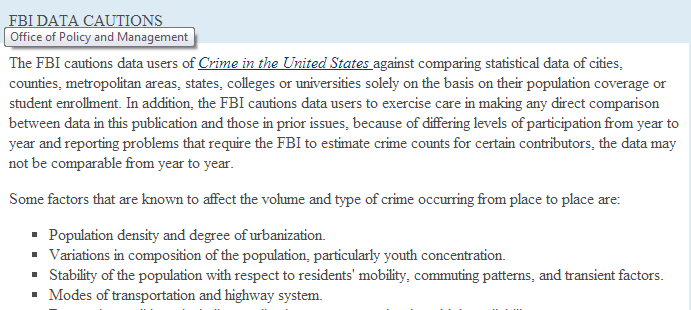
Have a look at the top of the list of factors that the FBI considers relevant to crime rates straight from the website of the Connecticut Office of Policy and Management:
(Click here to View Webpage)


Transit Oriented Development & Low-income Housing Mandates

  According to a recent press report:
"Housing policy experts see mixed-income housing as an alternative to concentrating low-income individuals and families into one building or one complex. The model is also being considered as an alternative to Section 8 housing vouchers that travel with the tenant. By dispersing small numbers of low-income families into market rate housing, the belief is that the low-income families will benefit from some of the same networking resources, and adapt the same behaviors as the market-rate tenants.
.....Low-interest loans from Connecticut Housing Financing Authority help lock in the financing. In Connecticut, Stamford, Norwalk, South Norwalk, Fairfield and Bridgeport have developments around their train stations. While New Haven County has been slow to embrace the concept, there are developments in Bristol and New London, and some existing property owners are designating units as affordable, said CHFA spokeswoman Lisa Kidder." (read here)
On a recent trip to Bristol's downtown, Richard Blumenthal stated that:
" the city could be eligible for federal community block grant funds or other U.S. Department of Housing funding that could be used to forge a public-private partnership with the Renaissance Downtowns developer, whose proposal for a large mixed-used development at the vacant 17-acre Depot Square property has faltered."
Click here to visit's HUD's Climate Adaption Plan

As stated on the internet on HUD's page,
"not less than 70 percent of CDBG funds must be used for activities that benefit low- and moderate-income persons."
And in addition, HUD is now mandated to promote and include sustainable development in their programs.
 From their websites:
"On October 5, 2009, President Obama issued Executive Order (EO) 13514, "Federal Leadership in Environmental, Energy and Economic Performance", which establishes numerous "green" requirements for the Federal Government.  E.O. 13514 requires federal agencies to establish greenhouse gas emissions reduction targets; increase energy efficiency; reduce fleet petroleum consumption; conserve water; reduce waste; support sustainable communities; and leverage Federal purchasing power to promote environmentally-responsible products and technologies."

"Climate change adaptation planning relates to both HUD’s mission statement and to HUD’s strategic plan. HUD’s mission is to create strong, sustainable, inclusive communities and quality, affordable homes for all. HUD’s strategic plan emphasizes its role in building sustainable communities and in promoting energy-efficient buildings and location-efficient communities, as well as its role in facilitating disaster preparedness."

The relationship between HUD funding, smartgrowth (aka sustainable development) projects and Bristol's plans are as follows.  The six livability principles mandated for eligibility for sustainable communities planning grants are the same as the six "Smart Growth" principles required in the draft of Bristol's Plan of Conservation and Development as now required by the 2013-2018 Connecticut Conservation and Development Policies Plan Update.  State laws, regional policies and required mandates require stipulations be met before funding is provided on the municipal level.  This is what is holding up the development in Bristol.  Community gardens and bicycle lanes are just a piece of the puzzle being assembled.

 State Law and City Ordinance Changes

A significant increase in the role of Connecticut's newly redrawn Councils of Governments will provide priority funding to projects meeting the three aspects of criteria.  The essence of the changes are of significant impact to the redevelopment of downtown Bristol.

Only the mayor would represent the people of Bristol on a regional board, providing one vote for your city as your representation on any project deemed "regionally significant". This language was slipped into the biennium budget bill (which was passed using Connecticut's ECERT process just before midnight in last year's session) In power and effect, the consequences ring in resemblance of the powers of county government, which was abolished in Connecticut in 1960 because it had become too powerful and ridden with corruption and abuse.
PA 13-247
 Within the framework of the Council of Governments of the Central Naugatuck Valley, projects that meet a criteria of size will be eligible for capital funding as illustrated in the image to the right.  To further solidify my point let me refer you to a statement made recently in a local paper.  One gubernatorial candidate expressed his intent to take the authority of the development approval process out of the hands of local officials and place it in the hands of the state.  Here is the excerpt:
( Click here to read the full story)

These projects have and will include subsidies for transportation and housing packaged together with economic development funds.  You can't have one without the other and this very measure has stirred much controversy in nearby Plymouth, CT where it narrowly passed adoption.


On Wednesday August 13th,

the Bristol city council voted on a resolution to change the city's ordinance to empower the city to participate in these regional projects by joining the Council of Governments of the Central Naugatuck Valley.
(Click here to view the report)

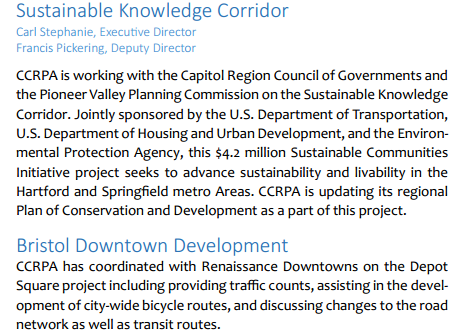
Regardless of what city officials may say, as a member of the Central Connecticut Regional Planning Agency, the regional planners have worked intricately on the details on the Depot Square Project in Bristol.  As I have detailed, the project is a regional project that includes the transportation, housing and economic development planning and collaboration of the regional authorities.  To be eligible for state funding there are guidelines that must be met.


Click here to visit the COGCNV website

Now as our state laws and policies are changing radically, one can only imagine the consequences.  It would appear that Bristol residents are  feeling the effects of the changes already. Were it not so, then why are answers impossible to come by?  (View the city's document here in the city's Agenda Center.)


How bad can central planning really get?