One planning guide that local regional planners are looking at has some interesting things for both planners and citizens to consider. The TOD 202 Guide to Station Area Planning is a publication by the federally funded nonprofit group Reconnecting America. Borne of the Great American Station Foundation and formed in 2002, their website states that ReconnectingAmerica.
"not only develops research and innovative public policy, but we also build on-the-ground partnerships and convene the necessary players necessary to accelerate decision-making." The map from their website indicates how expansive the nonprofit's efforts are. The Chairwoman of the Board of Directors of ReconnectingAmerica is Andriana Abariotes, whom is also the Executive Director of the Twin Cities Local Initiatives Support Corporation (LISC). LISC was chosen to manage the State of Connecticut's $15 million predevelopment and acquisition fund by Governor Dannel Malloy in 2014 as stated in this CHFA press release. The purpose of the fund is described as
"to provide financing that will encourage developers to carry out transit oriented development in communities with transit stops along the CTFastrak"
Bristol is at the farthest west end of one of the New CTFastrak bus lines as indicated by their service map. The expansion of a guideway is unlikely at current ridership levels. One need merely drive by city hall in downtown Bristol to find the mostly empty buses idling and waiting to shore up transit arrival times. Perhaps the efforts to increase density around it's Depot Square destination are to fill this purpose. Some very involved stakeholders have incredulously claimed that the busway and the project are completely unrelated. Nothing could be further from the truth.
As indicated at the Bristol Downtown Development Corporation's July meeting, the developer of the Depot Square project whom sought state funding for their high-density affordable housing development through the Department of Housing and Urban Development has applied for state predevelopment funds under the recommendation of the agency. With the State of Connecticut's Office of Policy and Management having given Bristol the designation of a Regional Center with Priority Funding, it has given the aforementioned document significance. This is not so much the association of the nonprofits involved but the simple fact that Bristol's Regional Council of Governments Planners are using these guides as a resource. To quote a recent reference from the President of the Central Connecticut Chamber of Commerce, "The devil may be in the details." Let's see if we can learn what to expect to come and what is already in the works by taking a look inside the guide.
Local reports from the media have described the downtown New Urbanism redevelopment as the transformation of Bristol into an "urban center". The focus seems to be almost the same in either case. A dedication to the creation of dense housing near public transportation is a key role in the expansion of transportation ridership. A Federal Transit Administration funded report called Transit-Oriented Development in the United States: Experiences, Challenges, and Prospects illustrates (among many other things) that the increase of ridership is the number one goal of transit agencies involved in transit-oriented development projects. This is precisely why developers and city leaders are encouraged to increase density in TOD projects..
According to Bristol's chosen master developer, the density for the Depot Square project is approximately sixty units per acre. This is a significantly higher density than most of the residential buildings in the city save for the obvious ones. I'd like to note that the developer is seeking CHAMP funding for targeting middle-income persons in need of affordable housing options. That may be an acceptable pursuit for some but one has to wonder what will happen if this housing does not become occupied by the demographic it is intended to be marketed to. What percentage of high-density residential buildings in the city do you suppose are primarily inhabited by people that are not living on assistance?
Either way, Regional Center or Urban Center, one can clearly see that the number of units targeted by planners in both are well over what Bristol's downtown currently offers. Some people have indicated that they think just a phase one building will be the end of the density created in the downtown. Almost all indications prove otherwise. The plan that Renaissance Downtowns has brought forward is underway as we speak. Under the Malloy administration, the majority of CT towns along the Metro North's New Haven Line have adopted TOD plans. The State Bonding Commission's most recent allocations of transportation funds left more than half of our transportation funds (more than $205 million) for "Bus and rail facilities and Equipment Including Rights-of-Way, Other Property Acquisition and Related Projects"
In addition to the creation of minimum density standards, the report makes suggestions regarding housing types and target goals for housing units to be created in the development.
Included in the ReconnectingAmerica TOD202 publication is a TOD checklist which is completely in line with the State of Connecticut Department's adopted "Complete Streets" guidelines and priorities in 2013. These guidelines commonly narrow roadways to include bicycle lanes to provide opportunities for those without automobiles. Of course, these people are described as those seeking alternative lifestyles that depart from conventional auto-centric lifestyles. I'm sure that these people exist somewhere where they are free from the hazards of snow and ice that makes this impossible for year round transportation options in the Northeast United States Tri-State area.
Among the numerous other indications that these transit-oriented projects are customarily planned outside the municipality, the document suggests that planners involve local planning commissions and city council members to "help ensure a public buy in". I could not help but notice there was no advocacy of pretending the entire plan was completely locally initiated. I guess some people involved in Bristol's so-called Unified Development Approach did not get the memo.
One can find the basis of the quality of life mantra for TOD in the charts provided by the ReconnectingAmerica's sister organization's "Center For Transit-Oriented Development."study. The measure to expand disposable income for struggling residents is focused upon the savings of household transportation expenses by decreasing automobile dependency. This is precisely the same ideology and source I previously found in both the CCRPA's recent Housing Draft Report with the information cited from a CT DOT official illustrated in one of my earlier blogs. Renaissance Downtowns' Concept Submission for their comprehensive downtown plan also refers to the same strategy that describes this method as an economic booster. With the massive subsidies required to implement the plan it will be impossible to recover the investment capital. This is precisely why I say that this plan can be better described as a social and environmental than one of economic development.
I'm sure that the local "Naysayer Branding Committee" will say that all this information put forth here is circumstantial regardless of the fact that these parties' plans for Bristol's future all contain the same references to what is clearly a central plan directed by special interests. How many uncanny similarities it will take to reveal to the public before they come clean remains to be seen, but for now we have a whole lot of people in this city whom have no intention of revealing much to the general public about how density, demographics and transportation plans are guiding the future of Bristol. Without revealing these details to the public while advocating for public monies for such investments is not only an immoral act but flies in the face of the very definition of representative government. Without such disclosure, the Plan of Conservation and Development's poll and accompanying public input amount to a farce or authoritarian consent form.
As pictured in the Renaissance Downtowns' Comprehensive plan, the Plan of Conservation and Development is a focal point in the redevelopment of Bristol. According to State of Connecticut Statutes, the POCD shall "...be a statement of policies, goals and standards for the physical and economic development of the municipality, ..." It appears to be out of balance as housing is mentioned nearly 100 times more than jobs in the document. From the beginning, it would appear that the outcome of the plan has been predetermined in part long before the public participation process began due to state mandates. My perspective has not changed.
This blog is an effort to extirpate the data and identify the top-down central planning as well as the bottom up grassroots input in an effort to preserve what representation the general public has. As you can see in the diagram on the right, Renaissance Downtowns' development strategy was inserted into the original draft of the Plan of Development. It was subsequently removed as controversy over the developer surfaced.
The first public workshop for the POCD was supposed to be an effort to provide public input into the plan. As you can see from the images below, the members of the public were outnumbered by members of Bristol's Planning Commission and some of their family members. There were about five Bristol residents whom attended as well as one member of the local press.
Glen Chadler of Planimetrics graciously granted me a short interview prior to the workshop commencing. In conversation after the interview, he agreed that it was unfortunate that so few members of the community were in attendance for the workshop. An article in the local paper can have a significant impact on the drawing of attendants. Unfortunately that did not happen in Bristol he indicated. There were however a few "Bristol Rising" members in the audience whom were apparently prompted of the event and their input can be observed in the final draft policy document.
Some residents played connect-the-dots while placing the dots on the map.
What I found to be quite astonishing was the representation of paper money as an indicator of development preference. I can only wonder if the participants associated their choices with the high costs to bring it to fruition. Of course, as the federal reserve has shown the American people as of late, when it comes to paper money, money is no object. I wanted to put the whole booty on "sprawl development" but there was no option to do so. Therefore I kept my booty as a souvenir and chronicled in video.
As you can see from the thumbnail below, residential development and housing diversity received the smallest pile of loot regardless of the attendants. This further supports my assertions that high-density apartments are not what Bristol residents support for future development. Among those whom commented at the meeting were two non-residents. One is in the real estate market and the other is an investor for the downtown development. Their input is represented in the final document.
The city has had several special meetings of the planning commission dedicated to the Plan of Conservation and Development's creation. As the only member of the general public in attendance, the chairman allowed me to participate in the discussion after raising my hand. I had encouraged others to attend as well to provide their input but many were convinced that the plan had little to do with the downtown project as residents were encouraged to attend the Downtown Development Corporation's public meetings to voice their concerns. There were however a few meetings that brought a few looking to provide their input. At the first meeting that this occurred the was a heated debate about the encouragement of density development in the neighborhood of one very concerned resident.
The outcome was not a favorable one. At least one member of the commission insisted that the meeting was not a public hearing and therefore public comment should not be allowed. This was contested by myself as the City Charter states clearly:
"Sec. 49. - Boards and commissions. Meetings. All board meetings shall be public and all meetings of boards or commissions whose duties involve the transaction of public business shall be held at accessible stated public places and all meetings and the minutes thereof shall be open to the public. Any elector shall have the right to appear and be heard at any such meeting as to any business proper to come before said board or commission."
Upon entering the next meeting we found these signs posted. There is technically nothing wrong with the rules that were applied as they do in fact comply with the charter. The unfortunate thing is that there were four members of the public that attended with the intention of offering some input. After an hour of patiently waiting they left, never to return. This drew the ire of more than one resident whom found the action reprehensible. Some resident prefer not to comment prior to a meeting. Does two hours or more wait to make public comment constitute any form of accommodation in your opinion?
The video below illustrates how the language contained in the Plan of Development has an effect on the gathering of capital. Should this fact shadow the will of the residents who provided input? The outcome of the POCD hearing and adoption shall in this case put an important question to the test.
The representative from the City of Waterbury on conference call is concerned that the Regional Council of Government's municipal members' Plans of Development are in compliance with the State's Plan of Development in the video below.
The question to be tested is :
"Is Bristol's Plan of Conservation a top-down plan or a bottom-up one?"
The issue of municipal control vs. regional control in the planning process is discussed by Council of Governments of the Central Naugatuck Valley members at their second meeting in the video below. Municipal plans are designated as policy documents by Connecticut general statutes. The City of Bristol recently joined this COG as the state realigned planning agencies in a manner that some say resembles county government. A few bills moving through the state legislature would solidify this transformation. Some legislation would open the floodgates for Tax Incremental Financing for municipalities in the State of Connecticut without the oversight of the state nor protections of citizen-driven referendum. These funding mechanism have bankrupted many a California city for specifically the same purpose they are being pushed in Connecticut: To fund Transit-Oriented Development projects. . The stakes are high for those living paycheck-to-paycheck.
As you can see in the video below, the City of Shelton's planning board representative indicates that their planned development allows the municipality to keep social services down. Shelton's tax rates have been consistently low without an increase in mill rate for 20 years. The city is growing faster than any other in the COG.
Bristol's approach in the Plan of Development appears to be a sharp contrast to that. A municipality with more affordable housing than all surrounding towns appears on the path to create more. Of course, the plan is not limited to the Depot Square parcel. The map below indicates the downtown "Enterprise Zone" may be a future "Housing Opportunity Zone." Housing Incentive Zones are customarily created to draw transit-oriented development to a municipality because low-income riders are the demographic that primarily occupy buses on off-peak operation hours and are typically included in transit-oriented projects due to federal mandates.
WILL STATE GUIDELINES FORCE MORE AFFORDABLE HOUSING TO BE BUILT IN BRISTOL?
Municipal plans of Development serve as a guide for regionally planned projects in regional centers such as Bristol's downtown.
Section 10 of Bristol's NEW 2015-2025 Plan of Conservation and Development's, "GUIDE RESIDENTIAL DEVELOPMENT" section states:
"As of 2014, approximately 13.5% of Bristol's housing stock was considered affordable (governmentally assisted or available to moderate income house‐holds), based upon the definition of "affordable housing" established under Section 8‐39a of the Connecticut General Statutes. The state minimum threshold for affordable housing is 10%. Bristol's affordable housing stock also exceeds the state average as well as that of surrounding towns.
"Only About 5 percent of those surveyed for the Plan of Conservation and Development identified a price‐related housing arrangement (affordable,subsidized, family) as their next housing choice.
HOWEVER, in accordance with the State of Connecticut's General Statutes 8-23, the Municipal Plan of Conservation and Development MUST :
"Show concentration of development around transportation nodes and along major transportation corridors to support the viability of transportation options and land reuse
*Show the commission's recommendation for the most desirable use of land within the municipality for residential, recreational, commercial, industrial and other purposes and for the most desirable density of population in the SEVERAL parts of the municipality.
*be designed to promote with the greatest efficiency and economy the coordinated development of the municipality and the general welfare and prosperity of its people.
*integration of planning across all levels of government to address issues on a local, regional and state-wide basis,
*make provision for the development of housing opportunities, including opportunities for multifamily dwellings, consistent with soil types, terrain and infrastructure capacity, for all residents of the municipality and the planning region in which the municipality is located, as designated by the Secretary of the Office of Policy and Management under section 16a-4a,
*promote housing choice and economic diversity in housing, including housing for both low and moderate income households, and encourage the development of housing which will meet the housing needs identified in the housing plan prepared pursuant to section 8-37t and in the housing component and the other components of the state plan of conservation and development prepared pursuant to chapter 297.
*In preparing such plan the commission shall consider focusing development and revitalization in areas with existing or planned physical infrastructure."
THESE STATE RECOMMENDATIONS ARE FOUND IN OUR PLAN FOR THE NEXT 10 YRS OF BRISTOL'S DEVELOPMENT
In section 10.2.2. of the POCD, "Housing Design" it is stated,
"Encourage the appropriate design of housing in order to meet community needs in the future.
In section 10.2.3., "Housing Diversity", it is stated, "Encourage the provision of a diverse array of attractive, decent, safe and sanitary housing to meet the social and economic needs of Bristol’s current and future population."
and in Section 10.3.3., "Housing Diversity", it states.:
1. Encourage the diversification of the local housing stock in appropriate locations (such as near services and/or transit) to meet the changing housing needs of current and future residents.
2. To help address current and future housing needs, consider permitting multi‐family development of appropriate density and design to be located:
in downtown Bristol in mixed use buildings,
along major commercial highway corridors, and
in other business districts or other suitable locations.
3. Strive to encourage the provision of:
affordable housing for the elderly who need it,
and affordable housing for families and individuals who need it.
THIS IS ONE-SIZE-FITS-ALL POLICY! Bristol ALREADY has more than it's fair share of diverse affordable housing stock!
Bristol's Final Draft of the Plan of Development identifies the local area's percentages of affordable housing as follows.:
Bristol's percentage of multi-family also exceeds both state averages as well as the percentages of surrounding towns. The Final Draft of the Plan of Development identifies those town's percentages of Multi-Family housing as follows.:
Bristol's percentage of renter-occupied housing also exceeds both state averages as well as the percentages of surrounding towns. The Final Draft of the Plan of Development identifies those town's percentages of renter-occupied housing as follows.: Percent Renter Occupied
One of the major problems with these Plans of Conservation and Development is that they are all basically identical in the manner that they dictate state policy of mixed-use transit-oriented development, which is the hardest type of development to find investment capital for. The state government that mandates the mixed-use smartgrowth development subsidizes it on the state level, encourages municipalities to further subsidize it with bonding, tax-incremental financing and future revenue schemes that place all the risk onto taxpayers. These types of projects are also inclusive of "affordable housing". What people need to ask themselves if they themselves want to live in a mixed-use public-transit-oriented community of dense development (such as the urban centers in the state that are already well established in a natural fashion) before they consent to funding it. Otherwise they may find themselves or their neighbors eventually forced out of their homes and into one of these developments due to the state's oppressive tax climate with more increases in the way.
As the survey indicates, less than 40% of residents in Bristol are working full-time and are likely on a fixed budget. Bristol is also the 13th most distressed community in the state with an average of one home foreclosure per day in the last quarter of 2014. Many are at a financial tipping point and this is likely the cause of the population decline as of late. Only jobs will stimulate real growth in Bristol.
Many have been silent about how the Plan of Development relates to Forestville. The city has apparently worked with a small group of individuals and organizations to complete a Forestville Plan that contains much of the same language as the plans for the Depot Project and the 2011 West End Plan that includes the straightening of route 72 and the "recently proposed" "bicycle paths". Like Newington, the plan will likely create two new urbanized areas along the busway as planning documents indicate.
Perhaps mandated, perhaps because of the low participation rate of the workshop, or perhaps it is a standard of practice, but for whatever reason the City of Bristol had a telephone survey of Bristol residents completed to provide input into the Plan of Development. Four-hundred heads-of households' answers were included in the raw data and conclusions. At this point one can again see the apparent disconnect between the respondents' answers and the POCD's conclusions. Development strategies can be seen in the outline to the right. The following images are from the raw data from the survey from Great Blue Research. The conclusions of the raw data surveyed from the contracted firm greatly differ from those in the city's POCD and I found it necessary to contest it in several forums both online and at city meetings. The will of residents should be upheld!
The survey data solidifies the conclusion that the residents of Bristol DO NOT support the expansion of affordable housing in Bristol's downtown or on the Depot Square parcel. This is VERY relevant to the incorrect assertion in the plan that the desire to see development of the site is synonymous with the creation of high-density housing on the parcel and surrounding area.
Some members of the community objected to contesting the conclusions of the survey. Should it's ability to attract market capital for something that the residents do not want take precedent over the preservation of representative government and the ability of the public to access public information for a survey commissioned with taxpayer money?
One member of the public addressed the issue of the lack of public outreach at the second POCD workshop. It would cost the city little money to advertise the opportunity to participate.
I took upon an effort to bring the raw data to the attention to the general public on a few of Bristol's social network groups. That effort was met with hostility by a select few individuals. The screenshots, data and links were subsequently deleted. The sad fact is that public discourse is consistently stifled when it comes to the TOD Agenda in Bristol's social networks. Some dissenting opinions led to the removal of individuals and a "no arguing with the administrator" policy. Even more disturbing is the statements and assertions of some of these individuals. Is "see no evil, speak no evil, hear no evil." their policy?
One would expect those whom are advocating for your tax dollars to be spent on the Housing Agenda would know all of the details but they refer to facts as opinions, documents as unrelated and defunct, and state policies as conspiracy theories. These propagandists use their slogans and narratives to back up their assertions. Any debate must be pointed towards agreement... or else.
Apparently blind with positivity, this faction of the cabal insists this is the only way. The consensus in some circles is that their goal is to promote the agenda of high-density housing in Bristol and to immediately stifle any dissent with ridicule. These are the hallmark tactics of left-wing radicals. When confronted with a direct question or logical argument, their actions replicate Saul Alinsky's Rule For Radicals #12.
As Wikipedia defines it :
“Pick the target, freeze it, personalize it, and polarize it.” Cut off the support network and isolate the target from sympathy. Go after people and not institutions; people hurt faster than institutions."
Sadly, public officials are members of these social networks but fail to make statements about the assertions. They remain wholly silent on the issue.
The tactic is as cookie-cutter as the TOD agenda itself and they go hand-in-hand with the agenda. It is best described by Newington resident Gail Budrejko who states that city taxpayers in their town have been labeled negative, fear-mongerers, and cop-outs, and been labeled as trouble makers for attending public meetings and raising their concerns.
"Labeling and name calling is an infantile and divisionary tactic often used when people don't have facts to support their position. "
Who can disagree?
Mrs. Budrejko also asserts that the city wholly ignored the survey results in proceeding with Newington's high-density busway-oriented agenda. Ironically, their Plan of Development was also performed by the same company as Bristol's. Their fight to preserve their town has reached a tipping point. Will it be too late for Bristol?
It would seem that the ONLY thing important to some Bristol officials is the Sustainable Development project for Depot Square. They claim they are trying to grow Bristol but what they are doing is limiting choices as to where and what businesses can be established. . Could this perhaps be the main cause of the lack of growth in the development in Bristol?
Some well known businessmen in the city seem to think that is the case according to their testimony at the Plan of Development hearing on June 3rd. The public hearing is a state requirement. As indicated in the statute,
"A plan of conservation and development or any part thereof or amendment thereto prepared by the commission or any special committee shall be reviewed, and may be amended, by the commission prior to scheduling at least one public hearing on adoption."
Bristol's Plan of Conservation and Development covers not only the downtown, but the entire city and it's development for the next decade. It is also a legal document that the state uses to claim their housing agenda is a bottom-up or grassroots plan. The author of this blog concurs that is far from the truth. As I have previously stated, the PoCD is a document that is used in consideration of the receipt of grant monies as clearly indicated by the grants administrator of Bristol's testimony at the PoCD hearing.
I admire the woman's honesty and she is doing precisely what her job entails. But if the PoCD is a document that is to represent a "vision", but the question remains, "Whose vision should it represent?". Section 8-23 of Connecticut's General Statutes states that the PoCD must consider "social, economic and governmental conditions and trends,"
Just exactly should these social trends to be obtained from in a bottom-up document? The Plan of development according to state statute also shall,
"be designed to promote, with the greatest efficiency and economy, the coordinated development of the municipality and the general welfare and prosperity of its people and identify areas where it is feasible and prudent."
The launch of the CTFastrak was ushered in at Bristol's Depot Square Saturday. As part of the State of Connecticut's initiative to lower carbon emissions while increasing transit ridership, billions are being invested across the state in public-private partnerships with the goal of building human settlements along the state's newly expanded transit corridors. Many local residents associate the new Bus-Rapid-Transit (BRT) as the "Busway to nowhere". Although the actual guideway structure has only been constructed as far as New Britain, Bristol's Depot Square development indeed sits at the opposite end of the Bristol-Hartford route.
The new buses offer free WiFi (until you reach your daily data limit) but trendy as advertised, the guideway was constructed to alleviate roadway congestion for commuters travelling to Hartford and the reason it seemingly ends "nowhere" became clear in my 2 hour and fifteen minute round-trip commute. The bus left Bristol's enterprise zone and then Plainville's housing incentive zone carrying less than ten passengers. Upon pulling into New Britain's Main Street station it became clear why the guideway ended there. Nearly twenty passengers boarded at this stop and as we approached Hartford we picked up anywhere from a couple to a half dozen passengers at each stop. The bus became clearly packed with passengers whom found standing room only upon reaching the state's capitol. So what does this have to do with the guideway stopping in New Britain instead of continuing to Bristol you ask?
The relevant fact is that grant monies for large scale infrastructure projects are awarded in accordance with ridership numbers and Bristol's ridership does not quantify such a large investment. It seems however, as though some individuals would like to change that as Bristol's planning documents indicate that Bristol's downtown will be the site of an intermodal transportation hub for years.
Many experts agree that when building Transit-Oriented projects it is essential to include an expansion of mixed-income housing. According to the Berkley University collaborative publication called "Transit-Oriented for All":
"...many cities have found inclusionary zoning ordinances and reduced parking requirements useful for stimulating new affordable housing construction. Cities working to create and preserve mixed-income transit-oriented neighborhoods can draw from an array of tested policies to find the right set of tools for achieving mixed-income transit-oriented communities."
We see this practice being implemented in the State of Connecticut's TOD strategy as communities with such designations are predominantly targeted communities. Plainville's town center has the "Housing Incentive Zone" designation while Bristol's West End has adopted an "Enterprize Zone" classification and has made changes to local zoning with the help of their chosen Master Developer working on the city's transit-oriented project.
The Enterprize Zone demographic requirements are as follows per state of Connecticut Statutes.
Primary census tracts must meet at least one of the following:
a poverty rate of at least 25%
an unemployment rate of two times the state average
at least 25% of the tract's population receives public assistance
Secondary census tracts must meet lower thresholds:
a poverty rate of 15%
an unemployment rate of at least 1/5 times the state average
at least 15% of the tract's population receiving public assistance
The "experts" in the publication also shed some light on the inclusion of low-income housing for transit projects as a necessary ingredient for the success of their goals. As stated in the paper:
"Because those without a car often use transit for non-work trips as well – e.g., trips to the store,
school or recreation – low-income households also play a crucial role in filling seats during “offpeak”
times. This makes transit service more efficient, while also paying dividends for the
region through less congestion. Mixed-income transit-oriented development helps ensure that
transit’s most frequent riders have access to transit, by placing a range of housing options
within walking distance of the station."
Title VI requirements indicate that people from all classes and races must have equal opportunities provided by such projects receiving federal grant monies and this is even posted on the busway wall. Nonetheless, a fixed guideway is not only the least cost effective method to achieve the goals of helping people out of poverty, but may leave people without proper access for decades withing for development to happen. Connecting residents with employment opportunities today requires a more diverse route than a fixed guideway provides and far too many state taxpayers cannot afford to construct all of the housing, infrastructure and keynesian job stimulus on this massive and aggressive scale. This makes me wonder if the city's actions taken in conclusion of their Raquel Kennedy Consulting Report regarding Fair Housing and transportation access will be bringing Bristol the Fastrak guideway.
The State of Department of Housing and Connecticut's Transit Oriented Development policy is to connect residents with opportunities. According to DOT director Michael Sanders, CT Transit is launching expanded feeder service with the launch of the CTFastrak. Whether or not this expansion meets the needs of local residents remains to be seen. I can only rely on the testimony of the public transit riders.
I had the pleasure of speaking with this bright resident (as well did both Bristol and Newington's town planners whom shared the ride back from Hartford with us) who gracefully granted me a video interview where he explains that the CTFastrak is a waste of money as it does not help the residents of Bristol who need public transportation the most. How do you think that the city plans to help them?
Today's circumvention of political processes has come to the forefront of the debate of local control, home rule, and the basic protections of personal private property. Governors Bill 6851. AN ACT ESTABLISHING THE CONNECTICUT TRANSIT CORRIDOR DEVELOPMENT AUTHORITY, was introduced by State Representatives Sharkey, Aresimowicz,and Senators Looney and Duff. This particular piece of legislation was apparently drafted to strongarm municipalities into developing their town centers in accordance with state desires. The bill illustrates what great lengths some officials will go to to implement an agenda against the will of the people they are elected to represent. Representative Gail Lavielle testified on March 6th that this bill would give,"absolute authority to a board of appointees to decide what would be built in your town within a half mile radius of any train or bus station.", providing the power of eminent domain to this new state authority in "consultation, not approval" of municipal leaders. As Lavielle stated ,this bill could have been drafted in a manner to include municipalities in the process,but it was not. The bill is described as "scary" by Rep. Dubitsky in the March 6th CTN Planning and Development Committee video.
According to Lavielle, if this bill passes, the newly formed State Authority could essentially do whatever it wants within this transit corridor . The effect of this legislation is that it could potentially transform a city like Bristol into an inner-city environment complete with high-rise "affordable housing" units near the planned development hub in Bristol's downtown.
The Connecticut Council of Municipalities submitted testimony against hb 6851, calling it "highly problematic". The CCM represents 156 towns and 96% of the state's population. Their testimony states the bill, "appears to remove or limit local control and input on any or all proposed Authority development projects."
DECD Commissioner Catherine Smith testified in favor of the state usurpation of municipal development authority. The purposes of the program and the goals of the corsortium are hilighted in her submitted testimony.
To the dismay of a great many residents and the surprise of State Representative and ranking member of the P&D Committee in the state capitol,Newington Council Marjority leader Terry Borjeson publicly testified in favor of granting authority to the State of Connecticut to take control of it's downtown development. If the bill were to pass,the newly formed State Authority would have the authority to use eminent domain and essentially do whatever it wants within this transit corridor .
Newington residents were not pleased to say the least.
Now is the time for the advocates of these plans for downtown to consider the fact that they have opened a proverbial Pandora's box and they must reassess the downtown plan in consideration of the current political environment.
It's a new year and most have reflected on their milestones of 2014, but not those who are only digging a sore spot on Despot Lot. The stakeholders' plans have had more extensions and brought more shame upon themselves than Milli-Vanilli on their night of Bristol infamy. Even the nationally covered Aaron Herndandez scandal has brought less public attention and ire among local residents. Yet some of these stakeholders have continued to bring more shame upon themselves by repeatedly publishing their fallacies and ad hominem attacks in local papers. Some of these players are so arrogant as to refer to detractors of a plan that has failed to reach each milestone promised to taxpayers as negative nellies, conspiracy theorists, naysayers, whiny and other repugnant terms. Some deny the irrefutable facts contained in regional planning documents, State of Connecticut public acts and statutes, DOT Guidelines, Bristol's Annual Action Plan, etc., and dismiss ANY argument as without merit without addressing one single fact.
These methods are the rules for radicals who purport to care about Bristol while slamming the predominant opinion of it's residents. I applaud the efforts of these mouthpeices of the establishment as they do a better job of illustrating how out-of-touch they are with the majority than I could. Yes, the stakeholders call it a conspiracy theory but call it whatever they may; a willing donor's public-private partnership is an unwilling man's cabal. To afford the public an opinion of their own should surely escape the limits of one's self-image of elitism.
We all want Bristol's future to be a success and for the downtown to be redeveloped but we the citizens of Bristol do not equate the success of this cookie-cutter, transit-oriented plan to the success of Bristol. We are informed citizens and see what is happening in surrounding Connecticut towns and cities. We are familiar with the Malloy/State of CT Department of Transportation and Department of Economic and Community Development's agenda. We read the city's minutes and documents and attend city meetings. We know that this plan is not the grassroots plan that the stakeholders purport it to be and we the people have spoken with disdain regarding building apartments on this lot. Nonetheless, minimum building requirements for the site have been removed from the developer agreement.
The City of Bristol's Plan of Conservation and Development draft (which is open to public comment at the Bristol Public Library on January 24th), suggests the city take action to create an expansion of dense affordable housing adjacent to transit. This document is a guide for the next ten years of Bristol's downtown development and will likely be used to codify a radical transformation of Bristol to a dense urban center in concert with the State of Connecticut's goals. Transportation Policy Forum Hartford, CT 12-3-14
There are no guarantees that the planners' goals of changing the demographics of the area will succeed and plenty of legitimate reasons to think they will not. Furthermore, 2012 FBI Statistics reflected in Table 8 and CT OPM City and Towns statistics prove that CT cities with higher density and populations have higher crime rates and the expansion of the CTFastrakto the downtown is unlikely to help the situation.
A recent survey by the planners show that rising taxes is the number one concern of Bristol residents. Can you find an urban center in Connecticut with lower taxes than Bristol? Check the Office of Policy and Management's website by clicking here. I bet the mouthpieces of Bristol's political propaganda can fruitlessly try, but will keep their findings hush and call it (and therefore you) irrelevant. Now is the time again for Bristol residents to stand up and speak their minds regarding their concerns of the future of their city. Change is coming. Will you let a small group of people leave you and your family to pull their wagon?
Bristolites like small-town character a lot...
But a group of transformers with big plans do not!
As those who asked why, weren't provided a reason.
The transformative plan does not fit locals' pleasin'.
The upscale shopping was hook, line and sinker,
But the mass of apartments and debt was the stinker.
It could be their heads weren't screwed on just right.
It could be Southeast Business Park debts were too tight.
Or perhaps that the state offering cash was too tempting,
For those special interests whose taxes we're exempting.
But those watching their budgets watched details get buried,
A public purse handout despite promised contrary.
Officials hoped opposers would be kept at bay,
And pull like a small dog with overweight sleigh.
Whether well intended, misguided, without choice or confused,
They pretended that there could be nothing to lose.
Sixty-thousand tax dollars and no input from town,
They renamed "Mum City" "All Heart", (doubled down)
So despite the predominant public dissension,
Subsidized infrastructure and a contract extension,
They said that two million was all we were funding,
In an effort to stop referendum from coming!
Then they claimed that the public and the markets had both,
Guided smartgrowth and the walkability approach.
And as those who weren't Gruber-ed knew better before,
The piazza promise was revoked evermore.
For the visions projected were on the back shelves,
And left for taxpayers to finance themselves.
And even more telling something was amiss,
The Fastrak was coming, Transit-oriented-ness.
So with free land and cash for a pie in the sky,
Residents demand the who's whos tell us WHY!
They claim, "It pays for itself with new tax revenues,"
"Just a smidgen of help, a few dollars of dues ."
"For a small group of people knows better than you"
"What Bristol wants, needs, and what it should do"
The plans for dense housing and increased population,
A social justice ladder of public transportation,
Is supported by those who have something to gain,
Denouncing the busway and pleading for train,
For instead of a focus on high unemployment,
They offered "vibrancy" to entice your endorsement.
For the property values near transit are higher,
Perhaps some will "flip" Bristol, then move to retire.
Then it's likely high crime rates and taxes ensue,
And force out Cindy, Lou and me and then you.
For grants from government aren't from Santa Claus,
They aren't gifts at all, they are DEBTS, bound by laws,
That take Christmas gift money from struggling residents,
And give them to agenda enablers as presents.
Perhaps Bristol's true heart, doesn't come from a plan.
From big government, developers, or their marketing man.
Maybe Bristol...perhaps...needs a little bit more!
The will of the residents should be restored!
(Needs three sizes more)
After more than a year of the issue first surfacing, the Bristol Press has made a change to their format
that will forever change the public dialogue in Bristol, CT. The change brings some civility to the comments section but is the downside worthy of the measure? Many elderly residents and those whom have shunned the popular social network of Facebook will forever be absent from public discourse in the forum. The change also leaves municipal employees fearful of retribution from disclosing their personal opinions regarding government overreach and improprieties. However, political insiders and special interests have applauded the change as productive to the promotion of Bristol's downtown revitalization. It is this particular issue that drew my attention at the start of the government's advocacy for such. In fact, it is my contention that the issue brought the actions of some local officials and stakeholders beyond the constitutional limitations of government intervention of free speech.
Video Credit Nutmeg TV Public Access (Fair use all rights reserved)
The action spurred one of the most commented stories of all time in the Bristol Press and was featured in the headlines of the popular Connecticut news source aggrage site "The Capitol Report". Those opposed to the project were seemingly "called out" as toxic to public view while those anonymously slandering "the naysayers" were left apparently unscathed.
The declarations of certain public officials has in fact resonated in my mind for quite some time, inspiring not only my newly found inspiration to advocate in defense of my rights but to commemorate the anniversary of the event in an address to the council.
The change of the new source's format could not come at a more awkward time as pointed out bylocal victim of abuse of private property rights. . This culmination of discontent was fueled by the disgust of commenters as an apparent extension was already decided behind closed doors. The comment thread had also escalated to a concerted effort to stop the development by way of referendum blocking a change in city ordinances regarding the planning region bringing the Fastrak to downtown Bristol. From what I can see, the story has apparently since disappeared from the internet, comments and all. I do however have an archive of the story from last year, which I will include directly in this blog for a brief period to reflect on those who will forever left out of the conversation. I'm guessing there will be much less of it at the expense of the people of Bristol.
You can view an archive of the story by clicking here.


 The map from their website indicates how expansive the nonprofit's efforts are. The Chairwoman of the Board of Directors of ReconnectingAmerica is Andriana Abariotes, whom is also the Executive Director of the Twin Cities Local Initiatives Support Corporation (LISC). LISC was chosen to manage the State of Connecticut's $15 million predevelopment and acquisition fund by Governor Dannel Malloy in 2014 as stated in this CHFA press release. The purpose of the fund is described as
 As indicated at the Bristol Downtown Development Corporation's July meeting, the developer of the Depot Square project whom sought state funding for their high-density affordable housing development through the Department of Housing and Urban Development has applied for state predevelopment funds under the recommendation of the agency. With the State of Connecticut's Office of Policy and Management having given Bristol the designation of a Regional Center with Priority Funding, it has given the aforementioned document significance. This is not so much the association of the nonprofits involved but the simple fact that Bristol's Regional Council of Governments Planners are using these guides as a resource. To quote a recent reference from the President of the Central Connecticut Chamber of Commerce, "The devil may be in the details."

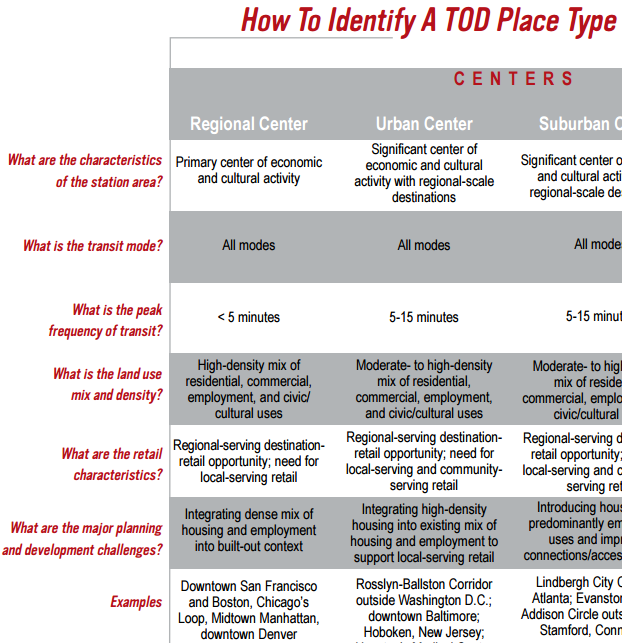

 In addition to the creation of minimum density standards, the report makes suggestions regarding housing types and target goals for housing units to be created in the development.

 Included in the ReconnectingAmerica TOD202 publication is a TOD checklist which is completely in line with the State of Connecticut Department's adopted "Complete Streets" guidelines and priorities in 2013. These guidelines commonly narrow roadways to include bicycle lanes to provide opportunities for those without automobiles. Of course, these people are described as those seeking alternative lifestyles that depart from conventional auto-centric lifestyles. I'm sure that these people exist somewhere where they are free from the hazards of snow and ice that makes this impossible for year round transportation options in the Northeast United States Tri-State area.


