

You may not have heard about it but the Bristol, CT City Council passed a resolution to submit a grant application for a Working Cities Challenge Grant. The planning grant is being offered by the Federal Reserve Bank of Boston and it's partners which consist primarily of local, regional and worldwide nonprofit philanthropic agencies.

According to the document, the initiative is, among other things, to address access to transportation. The United Way staff is partnered with the City of Bristol in this effort.
Although we don't know exactly how the planning grant will be used in relation to Depot Centre Square, we do know that the last time that the City of Bristol was included on a Challenge Grant application it was for Transit-Oriented Development relating to the Depot Square site.
We also know that the United Way has been instrumental in the efforts to provide more affordable housing near public transportation in the State of Connecticut. In fact, their ALICE Report was just referenced yet again at a recent forum attended by leaders across the state at the Lyceum in Hartford. The Partnership for Strong Communities forum on January 30th, 2017 was focused on how to shape local zoning to provide for affordable housing options. The ALICE (Asset-Limited-Income-Constrained-Employed) segment of the state's population is estimated at roughly 20% of those residents living in more than 85% of Connecticut's towns in the report. The report addresses hardships for the working segment of the population that is living paycheck-to-paycheck. I have included the wages of ALICE households under the heading of one sponsor of the program listed below.
A brief look into the priorities of the program and the vision statements of most of those organizations involved clearly indicates their goals are to help low-income residents as the city's document indicates. Of course, there is absolutely nothing nefarious about wanting to help those who are in need. But we must also keep in mind that it is important that the public is informed as to exactly how we go about doing so. This is especially the case when we are talking about public land and public money. Therefore, a little deeper digging showing where the program originates may provide Bristol residents some insight as to why it seems that all information about the planning of Bristol's future seems to have gone somewhat underground.
These initiatives can be found on the webpages of the many funders of the Working Cities Challenge Grant. I'm not going to list them all but I will include a few to illustrate the point. The following website states that Boston Fed's role in this partnership is to "design and implement the model in partnership with the Steering Committee".
Living Citiesis listed as one of the primary funders/partners of the Working Cities program. According to their website, the initiative is modeled after their "Living Cities" signature effort." Their page describes the structure of their model as follows on their website:
"...a Steering Committee comprised of leaders from the public, private, and philanthropic sectors. Living Cities is proud to serve as one of these partners and believes in the potential power of The Federal Reserve Banks as influencers, conveners, and research partners for enduring change in places. The resulting Challenge takes the shape of a competition whereby an independent jury of experts evaluates teams' applications against criteria that reflect the core elements of the Working Cities Challenge: leading collaboratively across sectors, engaging diverse community members, using evidence to track progress toward a shared goal, and working to improve the lives of low-income and residents of color by changing systems."
I'm not exactly sure what they mean by "changing systems" but it's kind of concerning to see any shape or form of what would normally be locally-driven decision making moving behind the doors of some ominous board from somewhere across state lines. I'm not sure if that's what the quote refers to but also concerning is the following statements from their site,
"We take risks, catalyze fresh thinking and test new approaches in order to creatively disrupt the status quo."
"... We blend public, private and philanthropic financial resources in new ways to better meet the needs of cities and their residents. ....We work with public sector leaders to foster more nimble, collaborative, and data-driven local governments."
A look at the funders page reveals that not only Living Cities, who is a primary funder of the Local Initiatives Support Corporation (LISC) (who is managing the State of CT Transit-Oriented Predevelopment Fund), but many of their other international funders as well. They are listed as, "Twenty two of the world’s largest foundations and financial institutions":
The Annie E. Casey Foundation
Bank of America
Bill & Melinda Gates Foundation
Citi Foundation
Deutsche Bank
Ford Foundation
The John D. and Catherine T. MacArthur Foundation
The JPB Foundation
The Kresge Foundation
The McKnight Foundation
MetLife, Inc.
Morgan Stanley
Prudential Financial, Inc.
Robert Wood Johnson Foundation
The Rockefeller Foundation
Surdna Foundation
W.K. Kellogg Foundation
Wells Fargo
I wrote a piece about funders for LISC's role in sustainable development in the State of Connecticut in a previous blog but it's noteworthy enough to mention that the following organizations are funders of both:
Ford Foundation
Bank of America
The Kresge Foundation
The McKnight Foundation
Living Cities
Citi
W.K. Kellogg Foundation
Wells Fargo
The Rockefeller Foundation
The Annie E. Casey Foundation
MetLife, Inc.
I've included a few notables in the "funders/partners" category and attached some quotes from their website that indicates their support of the goals of the grant program for Bristol's downtown project and those across the state for those interested in reading further:
- The State of Connecticut
- Worldwide Environmental Group Doris Duke Charitable Foundation
"Land Conservation in an Era of Climate Change- Our grant making is designed to provide frameworks and concrete examples of how practitioners can protect biodiversity in light of climate change through strategic land conservation"
"
- The Kresge Foundation- "Communities that address climate change head-on will be better prepared for new circumstances and uncertainties. Decisions about infrastructure, building design, land use, transportation and other policy and funding issues can make communities stronger, more equitable and more resilient to the changing climate. Our work is intended to help civic leaders consider a two-part climate question as they make decisions that shape the form and function of their communities."
"Environmental Stewardship in the Tri-State Area - In addition to being home to a majority of Americans, urban areas in the United States feature some of the most creative environmental efforts underway. The Doris Duke Charitable Foundation is fortunate to be headquartered in a particularly vibrant location – the greater New York City area – that features a number of cutting-edge efforts to help people live more efficiently and lightly on the land. Consistent with its emphases on wildlife habitat conservation and efficient built environments, and a growing focus on connecting people living in urban areas with the environment, the Environment Program uses a small portion of its resources to support innovative environmental projects in the Tri-State area."
- NeighborWorks America
"About Us -We are an organization that cares deeply about affordable housing and community development and the people who benefit from them." - Avangrid Foundation
"Sustainability and Biodiversity- The Avangrid Foundation is committed to supporting initiatives that focus on a sustainable energy model that can effectively meet energy needs and contribute towards protecting the environment...." - Boehringer Ingelheim Pharmaceuticals BI Cares Foundation
"36,000 TONS= The reduction in BI’s U.S. carbon dioxide emissions through its BE GREEN program." - Hartford Foundation for Public Giving
"The Foundation is intensifying efforts to build, join and support strong collaborations, and to forge creative, cross-cutting approaches. Collaborating with our communities, we will employ the following key strategies: Build, Sustain and Share Knowledge, Influence Public Policy, Inspire Philanthropy and Steward Resources, Invest in the Region" - Webster Bank
"Signature Programs- United Way- As a long-term partner, we believe strongly in the broad safety-net of human services provided by United Way and its partner agencies" - Eversource Energy
"We invested a record $783 million in our electric distribution system and $213 million in our natural gas infrastructure. Not to mention, an investment of $500 million in efficiency programs and measures that will save 11 billion kWh of electricity and 130 million therms of natural gas over their lifetime, as well as eliminate the emission of 5 million tons of carbon." - Liberty Bank Foundation-
(This first paragraph appears to be part of the United Way's ALICE Report)
"Did you know that our state has the 8th highest “housing wage” in the nation? This is the hourly wage a person working 40 hours a week would need to earn to pay for the average two-bedroom apartment, without spending more than 30% of their income on rent. In Connecticut, the housing wage is currently $24.29. That means that someone earning the minimum wage of $9.15 per hour would have to work 106 hours per week to afford that two-bedroom apartment. What’s more, almost half of Connecticut renters pay more than 30% of their income on housing — leaving them less to spend on the other necessities of life, and no cushion to protect them against life’s little surprises.
That’s why our foundation has adopted the creation of affordable and supportive housing as a key funding priority. When families don’t have a stable, affordable roof over their heads, it’s almost impossible for them to achieve stability or success in any other aspect of life. Here are some examples of items and activities we support with our affordable housing grants:
- Construction or rehabilitation costs for affordable and supportive housing projects
- Pre-development costs, such as market feasibility surveys
- Technical assistance to local developers and housing groups, usually offered by a larger nonprofit
- Education and advocacy efforts that build community support for affordable housing"
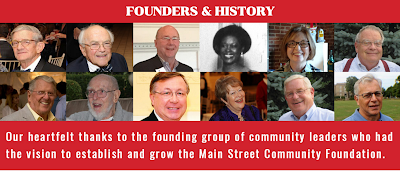
- Main Street Community Foundation
"MSCF is now recognized as an organization that knows about our community needs, and can help area citizens with charitable ventures whether funds are set up or not."

 |
| What exactly is this proposal supposed to be fnding? (Click here for bill status) |
Perhaps they know more about the program and the direction we are headed than the electorate. If that is the case then we have a lot to unwind before anyone can claim that the public is aware of, participated in or supports this endeavor.
I wonder if and when the residents of the city will become part of the process? Will the residents' role in the planning of this public project be reduced to an anonymous survey or will proper outreach efforts be taken to include the public? I would like to remain optimistic but there has not even been an acknowledgement that there is a transit-oriented project being worked on so I am not confident that best practices will be incorporated. Recent proposals to incorporate another overlay zone in Bristol without explanation as to it's purpose only exasperates these concerns.
Bristol is one of sixteen Connecticut municipalities selected for this program. Other communities include Bridgeport, Danbury, East Hartford, Hartford, Manchester, Meriden, Middletown, New Britain, New Haven, New London, Norwich, Torrington, Waterbury, West Haven, and Windham. Let us hope that if this grant is awarded that the citizens of the community are not hand-picked to participate while others are left in the dark. Unfortunately that's how this all appears to be playing out.


