Showing posts with label Open Government. Show all posts

Sunday, April 2, 2017

Is the Centre Square Plan the Same As the Depot Square Plan?


Is the new Centre Square Plan the same as the old Depot Square Plan?   I found many significant similarities.  If you take a look back at the Environmental Impact Evaluation (EIE) sponsored by the State of Connecticut Department of Economic and Community Development in August in 2010 you will find that the 17 acre parcel was part of a submission for a Challenge Grant for a Transit Oriented Development (TOD), mixed use intermodal transportation center.

According to the CT Department of Economic and Community Development (DECD) website, the projects' objectives were to, 
"...align(s) with HUD’s livability principles to provide more transportation choices. By planning and developing mixed-use, walkable, transit-oriented, and denser communities in the station areas...the project will help provide more transportation choices to a greater number of people.  ...DECD and its partners are promoting projects that are closely aligned to the HUD-DOT-EPA livability principles, which will help leverage federal investments. Since the adoption of the state’s smart growth policy, DECD has funded several TOD, mixed-income, and mixed-use development projects and is using the requested grant to leverage its investments.... and promoting equitable and affordable housing is discussed in more detail..."

The EIE Review notice posted on the State of Connecticut's Council on Environmental Quality's website indicates that the deadline for comments on the plan was October of 2010.  The state requires the EIE due to  the project's impacts on (among other issues) , "ambient noise levels,  historic, archeological, cultural, or recreational resources, disruption of an established community or neighborhood, displacement or addition of substantial numbers of people, or a substantial increase in traffic."  Because such projects require public funding residents are entitled to a public hearing if twenty-five residents or an organization representing more than 25 residents request one.   Do you remember hearing about this? The law requires it be posted outside the clerk's office and I'm sure it was but I'm not sure that has any impact on how many residents of Bristol knew.  It seems that, with but a few exceptions, the only time that numerous city officials actively encouraged residents to attend meetings about downtown Bristol that they were directed to the meetings for Bristol Rising whose meetings took place outside the framework of our government.


 This EIE performed by Fuss & O’Neill is cited in the City of Bristol's Request for Proposal (RFP) for "Professional Services Relative to Redevelopment of Downtown Bristol" posted on February 9th of 2016 resulting in the selection of Milone and MacBroom for site design for the Depot Centre Square site.   The environmental impacts of the proposed project to which the RFP refers to includes residential development as well as 50,000 square feet of office space.   

The "new" proposal from Bristol Hospital and it's developer Rendina for a medical office building is tailored to accommodate a building of this size according to a recent resolution from Bristol Development Authority.


The  Purchase and Sale Agreement Draft for the Bristol Hospital deal refers to both the bus stop relocation as well as the allocation of 3.5 parking spaces per 1,000 sq. ft. of building space.  Both details are significant.


The City of Bristol's Parking Study for Depot Square prepared by Tighe & Bond in 2010 also indicates plans for 55,000 square feet of office space as well as citing changes to Bristol's zoning regulations to reduce parking requirements for medical office buildings to 3.5 spaces per 1,000 square feet.  Coincidence?

The utilization of roadside space on Riverside Avenue for on-street parking is also mentioned in the 2010 document as well as in the current plan for the parcel.


What has changed?  Housing?  Transit? Parking?

As many residents have recently learned, the first phase of the project includes a transit stop in the center of the project site much like the Concept Plan created by Bristol Rising dated April of 2011 only it is now oriented around the CTFastrak instead of a rail station.  Because of the lack of population density to quantify the investment for light rail, this was likely the most probable outcome in pursuit of a TOD project in downtown Bristol.  The name may have changed but the game is the same.  The Depot is still at the literal Center of the Project.
Some officials still continue to refer to the workshops and public outreach of  Bristol Rising, (the community engagement group created by Renaissance Downtowns to gather community input and incorporate it into the plan), as the basis for the current plans for the development of the downtown.  Yet the Concept Plan presented to the public was not published until eight months after the EIE proposal was submitted.  How then could one possibly say that the basic elements of this project were derived from all of the members of the community?  You can see mention of a "strong residential component" in the image above.

In 2013 the City of Bristol made changes to it's Zoning Regulations that accommodate higher density residential development.  These changes encourage the development of more affordable housing.   Many people fail to recognize that none of that has changed.

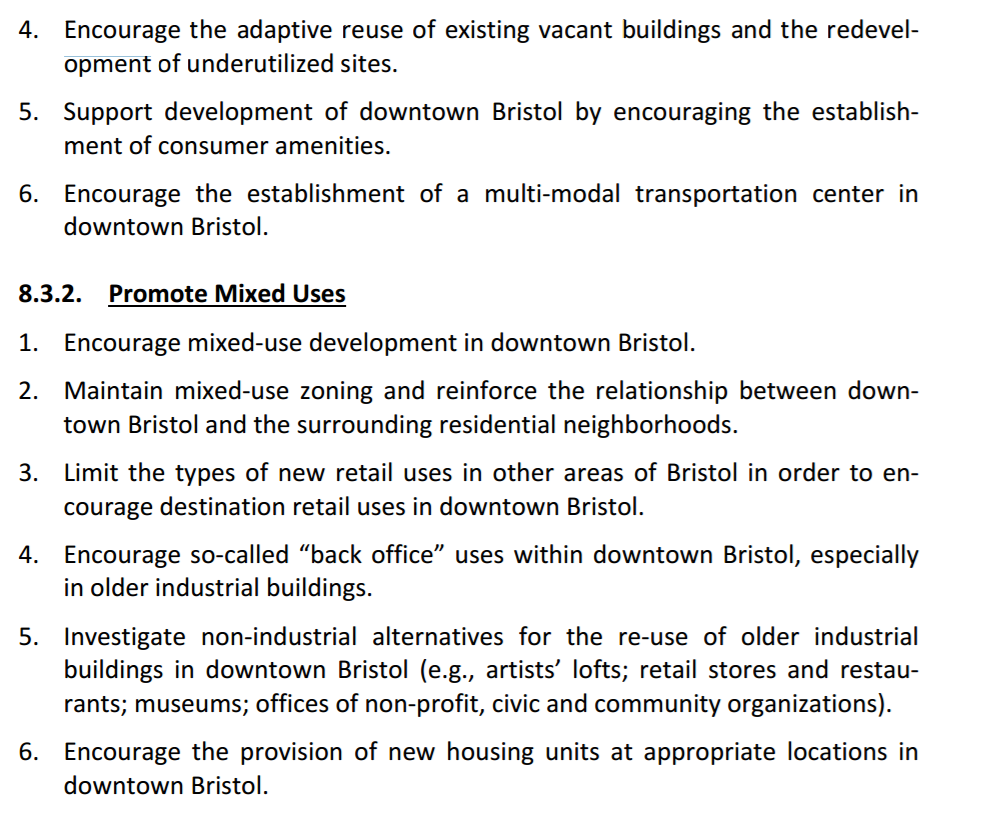
One can find these same goals now continue to exist in city plans made after the departure of Renaissance.  Bristol's 10 Year Plan of Conservation and Development, "is used to guide land use decisions and regulations, coordinate development activities within the city as well as provide programs for implementation." according to the city's website.  The establishment of a multimodal transportation center as well as encouraging the provision of new housing units in appropriate areas in downtown Bristol is included in this 2015 document.


Seemingly from out of nowhere, (like the Bristol Rising Concept Plan and like most other TOD projects) bicycle and pedestrian amenities have been integrated into the Centre Square Project.    The Preliminary Draft incorporates the equal sharing of space with automobile-oriented and non-motorized visitors in multimodal fashion.  Do you know where this idea came from?


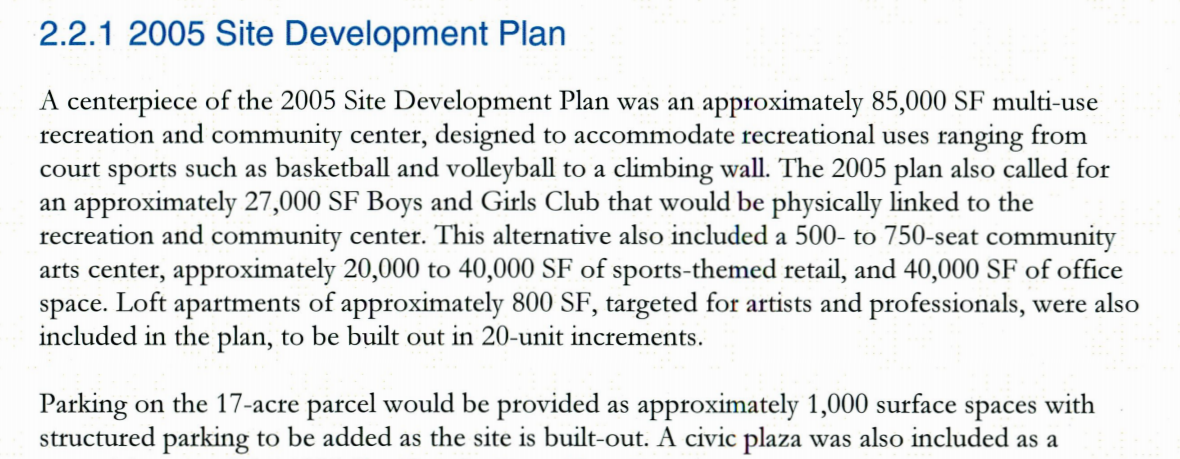
There are some more interesting facts contained in the Environmental Impact Evaluation dated August 2010, which can still be found on the city's website.  Here are a few worthy of thought.


They illustrate the  many things decided about the development prior to 2011 have not changed.   
A $14.3 Million renovation for a 500-750 seat Community Arts Center, a 40,000+ sq. ft. office building, an on-site structured parking during Depot Centre Square Project build-out, concerns over an increased demand on the area's healthcare system due to an increase in housing units, and a clue as to what the changes made to the zoning downtown can bring are included in the documents.   

Exactly what Public-Private Partnerships can do in Bristol is mentioned in a publication from an Architecture Faculty Member of the City College of New York's June Williamson and Professor of Architecture and Design at the Georgia Institute of Technology's Professor Ellen Durnham-Jones'  Retrofitting Suburbia.  Bristol Connecticut is mentioned in the book under the heading The Public Sector Takes the Lead.

"Developer Donald Monti of Renaissance Downtowns similarly blurs the conventional lines between public and private in his partnerships between public and private in his partnerships with small suburban cities, such as Bristol, Connecticut...Other downtown property owners are also invited into the arrangement."The Director of Bristol's Development Authority has recently stated that no kind of development has been ruled out.  What do you expect will develop under these conditions and exactly who did you expect to be interested in doing so?  Executive sessions for such projects may leave the public in the dark but needn't leave them unable to see what lies before them.  

Sunday, February 5, 2017

Public-Private Partnerships, Planning & Bristol's Depot Centre Square


 You may not have heard about it but the Bristol, CT City Council passed a resolution to submit a grant application for a Working Cities Challenge Grant.  The planning grant is being offered by the Federal Reserve Bank of Boston and it's partners which consist primarily of local, regional and worldwide nonprofit philanthropic agencies.  


According to the document, the initiative is, among other things, to address access to transportation.  The United Way staff is partnered with the City of Bristol in this effort.


  Although we don't know exactly how the planning grant will be used in relation to Depot Centre Square, we do know that the last time that the City of Bristol was included on a Challenge Grant application it was for Transit-Oriented Development relating to the Depot Square site.
We also know that the United Way has been instrumental in the efforts to provide more affordable housing near public transportation in the State of Connecticut.  In fact, their ALICE Report was just referenced yet again at a recent forum attended by leaders across the state at the Lyceum in Hartford.  The Partnership for Strong Communities forum on January 30th, 2017 was focused on how to shape local zoning to provide for affordable housing options.  The ALICE (Asset-Limited-Income-Constrained-Employed) segment of the state's population is estimated at roughly 20% of those residents living in more than 85% of Connecticut's towns in the report.  The report addresses hardships for the working segment of the population that is living paycheck-to-paycheck.  I have included the wages of ALICE households under the heading of one sponsor of the program listed below.


A brief look into the priorities of the program and the vision statements of most of those organizations involved clearly indicates their goals are to help low-income residents as the city's document indicates.  Of course, there is absolutely nothing nefarious about wanting to help those who are in need.   But we must also keep in mind that it is important that the public is informed as to exactly how we go about doing so.  This is especially the case when we are talking about public land and public money.   Therefore, a little deeper digging showing where the program originates may provide Bristol residents some insight as to why it seems that all information about the planning of Bristol's future seems to have gone somewhat underground.


These initiatives can be found on the webpages of the many funders of the Working Cities Challenge Grant.  I'm not going to list them all but I will include a few to illustrate the point.  The following website states that Boston Fed's role in this partnership is to "design and implement the model in partnership with the Steering Committee".


 Living Citiesis listed as one of the primary funders/partners of the Working Cities program.  According to their website, the initiative is modeled after their "Living Cities" signature effort."  Their page describes the structure of their model as follows on their website:

"...a Steering Committee comprised of leaders from the public, private, and philanthropic sectors. Living Cities is proud to serve as one of these partners and believes in the potential power of The Federal Reserve Banks as influencers, conveners, and research partners for enduring change in places. The resulting Challenge takes the shape of a competition whereby an independent jury of experts evaluates teams' applications against criteria that reflect the core elements of the Working Cities Challenge: leading collaboratively across sectors, engaging diverse community members, using evidence to track progress toward a shared goal, and working to improve the lives of low-income and residents of color by changing systems."

I'm not exactly sure what they mean by "changing systems" but it's kind of concerning to see any shape or form of what would normally be locally-driven decision making moving behind the doors of some ominous board from somewhere across state lines.  I'm not sure if that's what the quote refers to but also concerning is the following statements from their site, 

"We take risks, catalyze fresh thinking and test new approaches in order to creatively disrupt the status quo."
"... We blend public, private and philanthropic financial resources in new ways to better meet the needs of cities and their residents.  ....We work with public sector leaders to foster more nimble, collaborative, and data-driven local governments."

A look at the funders page reveals that not only Living Cities, who is a primary funder of the Local Initiatives Support Corporation (LISC) (who is managing the State of CT Transit-Oriented Predevelopment Fund), but many of their other international funders as well.  They are listed as, "Twenty two of the world’s largest foundations and financial institutions":
The Annie E. Casey Foundation
Bank of America
Bill & Melinda Gates Foundation
Citi Foundation
Deutsche Bank
Ford Foundation
The John D. and Catherine T. MacArthur Foundation
The JPB Foundation
The Kresge Foundation
The McKnight Foundation
MetLife, Inc.
Morgan Stanley
Prudential Financial, Inc.
Robert Wood Johnson Foundation
The Rockefeller Foundation
Surdna Foundation
W.K. Kellogg Foundation
Wells Fargo

I wrote a piece about funders for LISC's role in sustainable development in the State of Connecticut in a previous blog but it's noteworthy enough to mention that the following organizations are funders of both:
Ford Foundation
Bank of America
The Kresge Foundation
The McKnight Foundation
Living Cities
Citi
W.K. Kellogg Foundation
Wells Fargo
The Rockefeller Foundation
The Annie E. Casey Foundation
MetLife, Inc.


I've included a few notables in the "funders/partners" category and attached some quotes from their website that indicates their support of the goals of the grant program for Bristol's downtown project and those across the state for those interested in reading further:

  • The State of Connecticut
  •  Worldwide Environmental Group Doris Duke Charitable Foundation
    "Land Conservation in an Era of Climate Change- Our grant making is designed to provide frameworks and concrete examples of how practitioners can protect biodiversity in light of climate change through strategic land conservation"
    "
  • The Kresge Foundation- "Communities that address climate change head-on will be better prepared for new circumstances and uncertainties. Decisions about infrastructure, building design, land use, transportation and other policy and funding issues can make communities stronger, more equitable and more resilient to the changing climate.  Our work is intended to help civic leaders consider a two-part climate question as they make decisions that shape the form and function of their communities."
    "Environmental Stewardship in the Tri-State Area - In addition to being home to a majority of Americans, urban areas in the United States feature some of the most creative environmental efforts underway. The Doris Duke Charitable Foundation is fortunate to be headquartered in a particularly vibrant location – the greater New York City area – that features a number of cutting-edge efforts to help people live more efficiently and lightly on the land. Consistent with its emphases on wildlife habitat conservation and efficient built environments, and a growing focus on connecting people living in urban areas with the environment, the Environment Program uses a small portion of its resources to support innovative environmental projects in the Tri-State area."
  • NeighborWorks America
    "About Us -We are an organization that cares deeply about affordable housing and community development and the people who benefit from them."
  • Avangrid Foundation
    "Sustainability and Biodiversity- The Avangrid Foundation is committed to supporting initiatives that focus on a sustainable energy model that can effectively meet energy needs and contribute towards protecting the environment...."
  • Boehringer Ingelheim Pharmaceuticals BI Cares Foundation
    "36,000 TONS= The reduction in BI’s U.S. carbon dioxide emissions through its BE GREEN program."
  • Hartford Foundation for Public Giving
    "The Foundation is intensifying efforts to build, join and support strong collaborations, and to forge creative, cross-cutting approaches.  Collaborating with our communities, we will employ the following key strategies: Build, Sustain and Share Knowledge, Influence Public Policy, Inspire Philanthropy and Steward Resources, Invest in the Region"
  • Webster Bank
    "Signature Programs- United Way- As a long-term partner, we believe strongly in the broad safety-net of human services provided by United Way and its partner agencies"
  • Eversource Energy
    "We invested a record $783 million in our electric distribution system and $213 million in our natural gas infrastructure. Not to mention, an investment of $500 million in efficiency programs and measures that will save 11 billion kWh of electricity and 130 million therms of natural gas over their lifetime, as well as eliminate the emission of 5 million tons of carbon."
  • Liberty Bank Foundation-
    (This first paragraph appears to be part of the United Way's ALICE Report)

    "Did you know that our state has the 8th highest “housing wage” in the nation?  This is the hourly wage a person working 40 hours a week would need to earn to pay for the average two-bedroom apartment, without spending more than 30% of their income on rent. In Connecticut, the housing wage is currently $24.29.  That means that someone earning the minimum wage of $9.15 per hour would have to work 106 hours per week to afford that two-bedroom apartment. What’s more, almost half of Connecticut renters pay more than 30% of their income on housing — leaving them less to spend on the other necessities of life, and no cushion to protect them against life’s little surprises.

    That’s why our foundation has adopted the creation of affordable and supportive housing as a key funding priority. When families don’t have a stable, affordable roof over their heads, it’s almost impossible for them to achieve stability or success in any other aspect of life.  Here are some examples of items and activities we support with our affordable housing grants:
  • Construction or rehabilitation costs for affordable and supportive housing projects
  • Pre-development costs, such as market feasibility surveys
  • Technical assistance to local developers and housing groups, usually offered by a larger nonprofit
  • Education and advocacy efforts that build community support for affordable housing"
  • Main Street Community Foundation
    "MSCF is now recognized as an organization that knows about our community needs, and can help area citizens with charitable ventures whether funds are set up or not."
What exactly is this proposal supposed to be fnding? (Click here for bill status)
The interesting thing about the Main Street Community Foundation being a participant in the program is that there are members of Bristol's boards and commissions as well as elected representatives that founded the nonprofit.
Perhaps they know more about the program and the direction we are headed than the electorate.  If that is the case then we have a lot to unwind before anyone can claim that the public is aware of, participated in or supports this endeavor.

I wonder if and when the residents of the city will become part of the process? Will the residents' role in the planning of this public project be reduced to an anonymous survey or will proper outreach efforts be taken to include the public?  I would like to remain optimistic but there has not even been an acknowledgement that there is a transit-oriented project being worked on so I am not confident that best practices will be incorporated.  Recent proposals to incorporate another overlay zone in Bristol without explanation as to it's purpose only exasperates these concerns.

  Bristol is one of sixteen Connecticut municipalities selected for this program.  Other communities include Bridgeport, Danbury, East Hartford, Hartford, Manchester, Meriden, Middletown, New Britain, New Haven, New London, Norwich, Torrington, Waterbury, West Haven, and Windham.  Let us hope that if this grant is awarded that the citizens of the community are not hand-picked to participate while others are left in the dark.  Unfortunately that's how this all appears to be playing out.

Sunday, January 29, 2017

Overlay Zones, Busways, Public Info. & Railroading

   Where exactly is the new Overlay Zone proposed for the Farmington Avenue going to lay? Will this new zone change allow for buildings much higher than the current regulations?  Will it allow development that obstructs views or broadcasts unwelcome light or sound?  Will it lead to more traffic congestion? Will it allow people to subdivide and sell their properties in all areas of Route 6? Property owners want to know how these future plans are going to affect their own future and the values of their properties.  So after waiting more than ninety minutes to bring their concerns forth, they did so hoping their questions could be answered.  For the most part they were not.  Residents were allotted three minutes and spoke beyond that time limit but the responses and discourse was minimal.

The Special Meeting of the Planning Commission began with a 1-hour presentation of the recommendations from Fitzgerald and Halliday for the future of Bristol along Route 6.  The speaker seemed to be addressing the commission during the majority of the presentation.  It became clear that she was when she asked if there was still any concerns about the increase in density.  Our city planner responded that this concern was brought up by a resident.  The meeting then moved on without discussion of the issue.


There was little indication nor discussion from the city planner nor any members of the Planning Commission as to what purpose the creation of an overlay zone would serve during the Special Meeting on Wednesday January 25th.  In fact, the only members of the commission that indicated any concerns at all during this meeting or last December's were Commissioner Andrew Howe and City Engineer Paul Strawderman.  Of course this would make any resident feel uneasy about trusting this new proposal will not have a negative impact on their quality of life. 


Why would the city propose an overlay zone instead of just making a general zone change or allowing new development by special permit process?  The city planner's explanation during the meeting was that it would provide flexibility of having two possible options but we do not know what the intention nor specifications of these new options are.  I asked at the meeting but I was not afforded an answer.  I therefore had to ask Google.  


According to information aggregated on the website TransformingBristol, Overlay Zones are for:
*Development in Environmentally Sensitive Areas (most common use) 
* Protection of Historic Districts in Development Areas 
*Encouraging Dense Cluster Development Along Bus or Rail Corridors
...for more about Overlay Zones click here.
The top result of the Google search, "Why an overlay zone" produced the following information:

"CREATION
Any governmental unit with the power to create zoning districts can create an overlay district. There are three basic steps to creating an overlay district:

Define the purpose of the district. The district should have a clearly defined purpose e.g. to protect drinking water, preserve historical character, minimize erosion from storm water runoff, etc. Identify the areas that make up the district. Mapping district boundaries will depend on the natural or cultural resources and the geographic areas that relate to achieving the purpose of the district. For example, if the purpose of the zone is to protect groundwater, important groundwater recharge areas and areas prone to pollution, such as fractured bedrock or areas with a high groundwater table should be mapped.. Develop specific rules that apply to the identified district. In a groundwater recharge district for example, provisions may restrict development or require development guidelines that capture and filter water runoff.. 
It is critical that the zoning provisions offer clear guidance to both property owners and the governing body charged with approving proposals. Zoning requirements must be applied equally over all properties within the district. The ordinance not only must comply with any state and federal regulations, but must also be consistent with the goals, objectives, and policies of the municipality’s comprehensive plan. It is important that the local governing body involve the public to clarify issues and explain the reasons behind mapping district boundaries.

An educational program targeting developers and affected property owners will help increase awareness and compliance with the new requirements. The procedures for adopting an overlay district are the same as for adopting a zoning or rezoning provision. The overlay provisions as well as changes to the zoning map must be approved by the local governing body for adoption."

Image from top search result
   
  I'm not convinced that the City of Bristol has sufficiently undertaken these efforts.  There is still time for sufficient public outreach, healthy public discourse and informing of the affected public about the details of this overlay zone.  

What actions do you feel that study stakeholders and city officials should take to ensure an amiable outcome in this situation prior to the adoption of the plan?  Will we see statutory minimum efforts or outstanding makings of an "A" effort?  Time will tell.